Manufacturing has always been a discipline of trade-offs speed against cost, customisation against volume, flexibility against repeatability. Over the past decade, 3D printing mass production has steadily climbed the agenda of operations and engineering leaders worldwide. The question is no longer whether additive manufacturing can produce parts at scale; it is when and for which use cases it makes commercial sense.
This blog unpacks what additive manufacturing for mass production actually delivers, where its limits sit today, and how to think about it alongside conventional methods like injection moulding.
What Is 3D Printing Mass Production?
3D printing mass production refers to using additive manufacturing systems FDM, SLA, MSLA, SLS, MJF, DMLS to produce parts in volumes that traditionally belonged to injection moulding, casting, or CNC machining. Instead of building tooling and dies, manufacturers build digital print files and run them across one machine or hundreds.
With scalable additive manufacturing, designs can be complex without raising cost-per-part. Tooling changeovers disappear. Inventory can move from warehouses to digital files. And manufacturers can switch production from one part to another in minutes rather than weeks.
That said, scale still requires planning multiple machines, automation, post-processing, and quality systems. Mass production with 3D printing is not “press print”; it is a complete production discipline.
How Scalable Is 3D Printing for Manufacturing?
The honest answer: it depends on technology, materials, geometry, and volume.
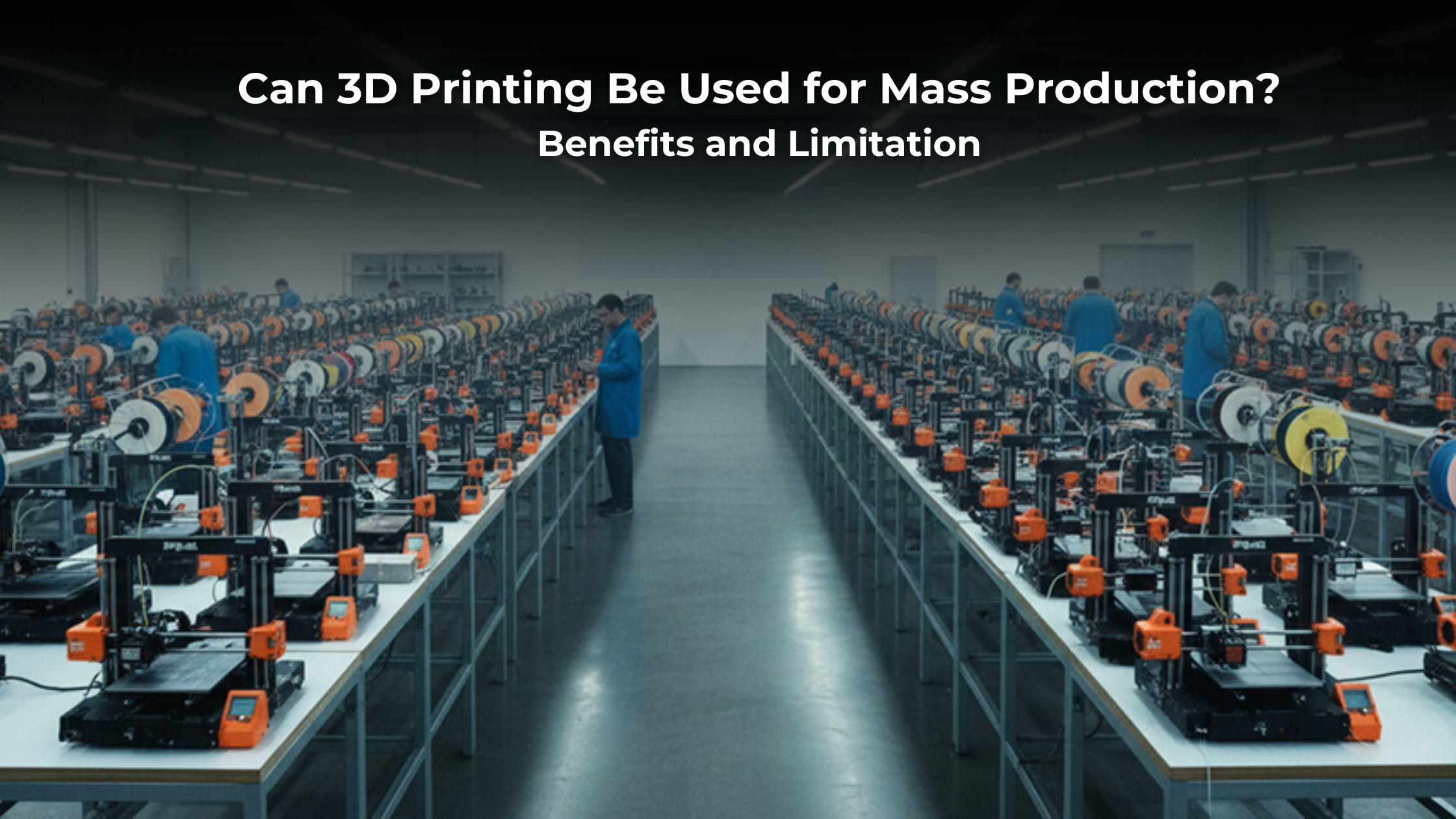
A single industrial FDM or resin machine can typically deliver tens to hundreds of parts a day. A farm of 10–50 networked desktop printers sometimes called a print farm can comfortably produce thousands of small parts a week. At the high end, MJF and SLS systems push parts-per-day numbers that begin to rival low-volume injection moulding.
To scale 3D printing for manufacturing, three investments matter most: workflow automation, consistent calibration across machines, and robust post-processing. With those in place, additive manufacturing becomes a genuinely viable mass-production option for the right part families.
Industries Already Using 3D Printing at Scale
Several sectors have moved well past prototyping and into volume additive production.
Automotive
Carmakers use 3D printing for lightweight components, customised interior parts, and tooling jigs and fixtures. Lighter parts improve fuel efficiency and EV range; tooling printed on demand eliminates downtime waiting for suppliers.
Aerospace
Aerospace OEMs print complex internal geometries lattices, conformal cooling channels, integrated brackets that consolidate dozens of subassemblies into one part. The result is lower weight, fewer fasteners, and lower fuel burn over a part’s life.
Healthcare
Healthcare manufacturers use additive technology to produce patient-specific implants, surgical guides, dental aligners, and prosthetics. Customisation that once cost a premium now sits in the standard workflow.
These industries are not experimenting any more they are running additive lines alongside traditional production.
Benefits of 3D Printing in Mass Production
The advantages that matter most to operations leaders:
• Customisation at no extra cost. Every part can be unique without retooling.
• Production efficiency. Digital workflows reduce manual intervention, lower error rates, and shorten the path from CAD to finished part.
• Material efficiency. Additive processes deposit only the material the part needs, dramatically reducing waste compared with subtractive machining.
• Faster product development. New designs reach customers in days, not quarters.
• Inventory reduction. On-demand production lets you replace warehouse stock with digital files.
For many product categories spare parts, low-volume specials, customised consumer goods these benefits already outweigh the cost-per-part premium.
Is 3D Printing Cost-Effective for Large-Scale Production?
It is the single most common question, and the honest answer requires nuance.
For low- to mid-volume production (roughly 1–10,000 units per part per year), additive manufacturing is often the cheapest method overall once you include tooling, lead time, and inventory cost. There is no mould to amortise, so the first part costs the same as the thousandth.
For very high volumes (hundreds of thousands or millions of identical parts), injection moulding usually wins on cost-per-part. The mould investment spreads across so many units that per-part cost drops well below what additive can match today.
The honest framing is therefore not “additive vs injection moulding” but “what is the crossover volume for this specific part?” For complex parts, that crossover sits surprisingly high.
When to Use 3D Printing vs Injection Moulding
A practical decision frame:
• Choose 3D printing for: low to medium volumes, complex geometries, frequent design changes, customised parts, spare parts, and bridge production while tooling is being built.
• Choose injection moulding for: stable designs in very high volumes, simple geometries, parts where surface finish and dimensional tolerance are critical at low cost.
The two methods are increasingly used together additive for early production and short-lifecycle SKUs, injection moulding for the long-running winners.
Limitations of 3D Printing in Manufacturing
Additive manufacturing also has real constraints. Understanding them prevents expensive missteps.
• Speed. Printing remains slower than injection moulding for simple, high-volume parts.
• Material range. Engineering plastics and metals are growing fast, but the additive material library is still narrower than conventional manufacturing.
• Surface finish & dimensional tolerance. Most parts need post-processing sanding, vapour smoothing, or machining for production-grade finish.
• Barriers at very high volumes. Beyond a certain volume, traditional methods still outperform additive on unit cost and cycle time.
These are the genuine limitations of 3D printing in manufacturing not deal-breakers, but factors to design around.
Challenges of 3D Printing in Mass Production
Beyond raw capability, operational challenges decide success at scale.
• Cross-machine consistency. Variations in calibration, ambient temperature, or filament batches can shift dimensions between machines. Statistical process control matters.
• Capital intensity. Industrial 3D printing systems still cost lakhs to crores. Smaller players need to choose between desktop print farms and individual industrial machines.
• Skill and training. Operators must understand slicer settings, material handling, and post-processing a different skill base from CNC or moulding operators.
These challenges are solvable, but they need to be planned for from day one.
Best 3D Printers for Mass Production

For production-grade additive work, the printer choice matters enormously. The qualities to look for:
• High uptime and continuous-print reliability
• Strong material compatibility (engineering plastics, fibre-reinforced filaments, resins)
• Integration into networked workflows
• A solid spare-parts and service ecosystem
3idea Technology stocks production-ready machines across all major categories Bambu Lab (X1E, X1 Carbon) for high-speed FDM at scale, Snapmaker U1 for modular professional setups, and Elegoo Saturn-class resin systems for high-detail volume printing. Explore the full lineup: https://www.3idea.in/products/3d-printers.
Can 3D Printing Replace Mass Production Methods?
The shorter answer: not entirely, and not yet.
For now, additive manufacturing complements traditional production rather than replacing it. It dominates customised, complex, and short-lifecycle parts. It loses to injection moulding for ultra-high-volume commodity parts. The most sophisticated manufacturers run hybrid lines — additive for early-life, customised, and spare parts; traditional methods for mature, high-volume SKUs.
That balance will keep shifting as printer speeds, material costs, and automation improve.
The Future of Additive Manufacturing
Three trends will reshape the next five years:
• AI-driven print monitoring that detects failures in real time and self-corrects.
• High-speed CoreXY and continuous-print systems that close the cost gap with conventional methods.
• Distributed production networks where parts are printed at the point of consumption rather than shipped from one factory.
Each of these makes additive more viable for mass production, not less.
Conclusion
3D printing has matured into a genuine production technology. The benefits of 3D printing in mass production — customisation, flexibility, material efficiency, faster cycles — make it indispensable for many product categories. The limitations are real but increasingly narrow.
For Indian manufacturers, the right question is not “should we adopt additive?” but “which parts in our portfolio should we move first?” Start there, build operational competence, and let the technology scale alongside your demand.
Explore production-grade 3D printers from leading global brands at 3idea Technology: https://www.3idea.in/products/3d-printers