
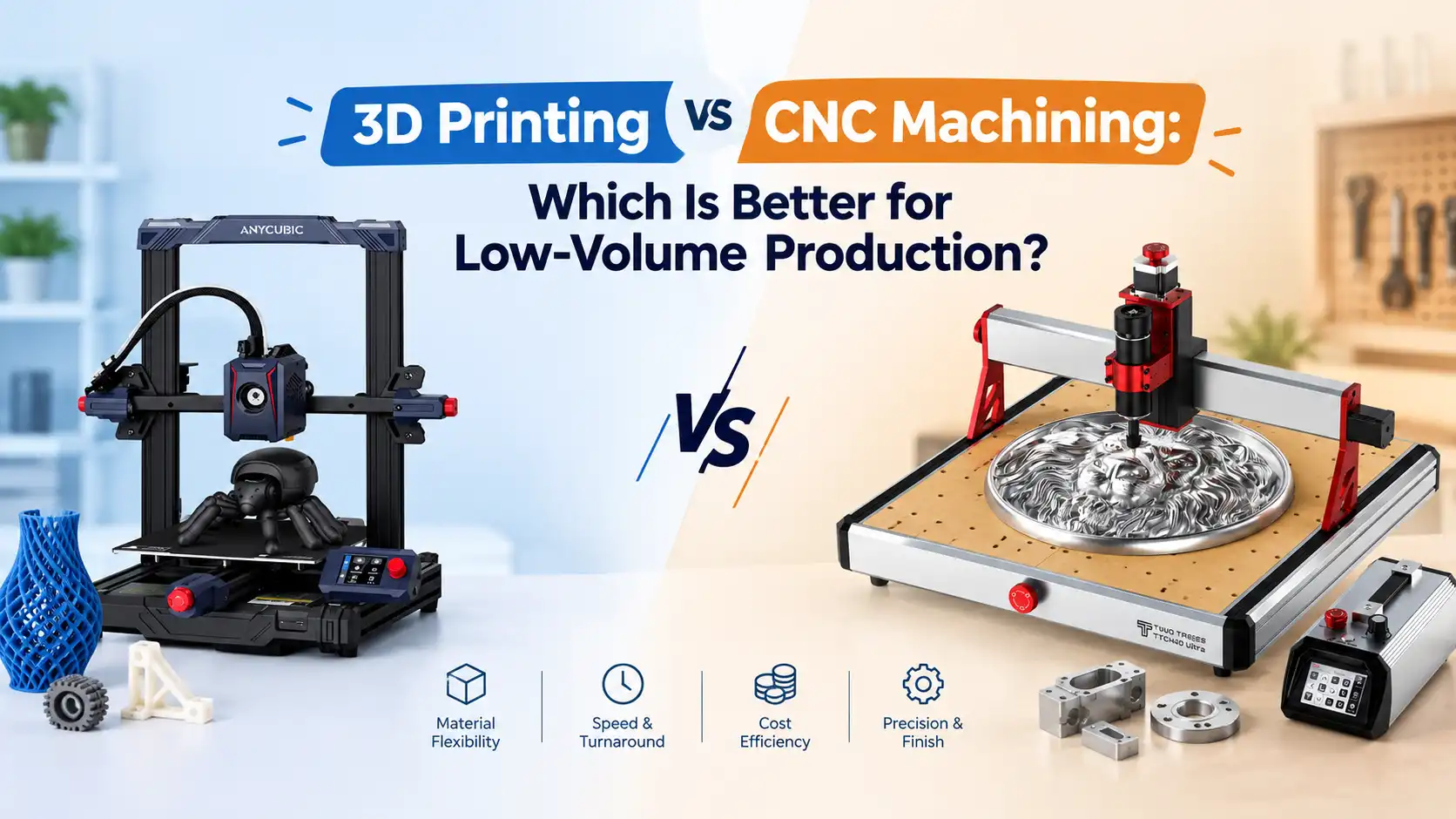
Manufacturers today face increasing pressure to deliver products faster, reduce upfront investment, and adapt quickly to changing customer demands. Whether producing prototypes, custom parts, or small production batches, selecting the right manufacturing process can significantly impact costs, lead times, and product quality.
One of the most common questions businesses ask is: Should you use 3D printing or CNC machining for low-volume production?
Both technologies offer distinct advantages, but the ideal choice depends on factors such as quantity, material requirements, design complexity, and performance expectations. In this guide, we'll compare 3D printing vs CNC machining across key decision-making criteria to help manufacturers choose the most suitable process.
Understanding Low-Volume Production
Before comparing technologies, it's important to define what constitutes low volume production.
In manufacturing, low-volume runs generally fall into two categories:
1–100 units: Prototypes, custom products, and pilot production.
100–1,000 units: Small batch manufacturing and market testing.
Industries frequently using low-volume manufacturing include:
Automotive
Aerospace
Medical devices
Consumer products
Industrial equipment
Electronics
These sectors often require rapid design changes, custom components, or limited production quantities that do not justify large-scale tooling investments.
What Is 3D Printing?
3D printing, also known as additive manufacturing, creates parts by building material layer by layer from a digital design.
Popular technologies include:
FDM (Fused Deposition Modeling): Commonly used for functional prototypes and affordable production parts.
SLA (Stereolithography): Produces highly detailed parts with smooth surface finishes.
SLS (Selective Laser Sintering): Ideal for durable engineering components and complex geometries.
Key advantages include:
No tooling requirements
Fast design iterations
Reduced material waste
Complex geometry capability
On-demand manufacturing
These benefits make additive manufacturing highly attractive for custom and short-run applications.
What Is CNC Machining?
CNC machining is a subtractive manufacturing process that removes material from a solid block using cutting tools.
The most common CNC processes include:
Milling: Rotating tools remove material to create precise shapes and features.
Turning: Material rotates while cutting tools shape cylindrical components.
Key advantages include:
Exceptional dimensional accuracy
Superior surface finish
Wide range of production-grade materials
Consistent repeatability
Because of these strengths, CNC machining remains a preferred choice for many functional and end-use applications.
3D Printing vs CNC Machining Comparison
When evaluating 3D printing vs CNC machining, several factors influence the final decision. While both technologies deliver quality results, their strengths vary depending on production requirements.
Cost Comparison for Low-Volume Production
Cost is often one of the most important considerations when evaluating manufacturing options.
Tooling Costs: One of the biggest advantages of additive manufacturing is the absence of tooling. Since no molds, dies, or fixtures are required, low volume production projects can often begin immediately.
Setup Costs: 3D printing typically requires minimal setup compared to machining, reducing initial project expenses.
Labor Costs: Complex CNC operations often require skilled machinists and multiple setups, increasing labor costs.
Material Costs: Although some 3D printing materials can be expensive, overall costs are often lower for smaller quantities due to reduced waste.
For many short-run projects, 3D printing vs CNC machining comparisons reveal that additive manufacturing offers a lower total production cost.
Speed Comparison
Speed can significantly impact product development cycles and time-to-market.
Design-to-Part Time: A 3D printed component can often be produced within hours of finalizing the CAD model.
Rapid Prototyping: Additive manufacturing allows multiple design iterations without additional tooling or setup costs.
Production Turnaround: For custom parts and small batches, 3D printing generally delivers faster turnaround times.
CNC machining may require programming, fixturing, and setup procedures before production begins.
As a result, many businesses choose additive manufacturing for projects requiring rapid delivery.
Material and Strength Comparison
Material selection often plays a major role in process selection.
Common 3D Printing Materials
PLA
PETG
ABS
Nylon
Engineering-grade polymers
Common CNC Materials
Aluminum
Steel
Titanium
Brass
Engineering plastics
While modern additive manufacturing materials continue to improve, CNC machining still offers broader access to high-performance metals and production-grade materials.
For applications requiring extreme strength, heat resistance, or durability, machining often provides an advantage.
When Should You Choose 3D Printing?
There are several situations where additive manufacturing becomes the preferred solution.
Choose 3D printing when you need:
Rapid prototyping
Complex geometries
Custom part manufacturing
Small batch manufacturing
On-demand production
Reduced upfront costs
For businesses focused on innovation and speed, additive manufacturing provides significant flexibility.
It is often considered the most efficient option for low volume production projects involving frequent design revisions.
When Should You Choose CNC Machining?
Despite the growth of additive manufacturing, machining remains essential for many applications.
Choose CNC machining when you require:
Tight engineering tolerances
Premium surface finish
Metal components
High-performance materials
Functional end-use parts
In these situations, CNC machining often delivers superior consistency and mechanical performance.
Real-World Use Cases
Startup Product Development
Startups frequently rely on 3D printing to accelerate product development while minimizing upfront investment.
Recommended Method: 3D Printing
Aerospace Fixture Manufacturing
Many aerospace companies combine both technologies to optimize development and production.
Recommended Method: Hybrid Workflow
Production-Grade Metal Components
Industries requiring high-strength metal parts often favor machining.
Recommended Method: CNC Machining
These examples demonstrate that the best manufacturing method depends on the application's specific requirements.
Can 3D Printing and CNC Machining Work Together?
Absolutely.
Many manufacturers use a hybrid workflow that combines the strengths of both technologies.
A common approach includes:
Design and prototype using 3D printing
Validate form, fit, and function
Refine the design
Produce final components using CNC machining
This strategy reduces development time while ensuring final production quality.
Rather than viewing 3D printing vs CNC machining as competing technologies, many businesses benefit from using both throughout the product lifecycle.
Final Verdict
The answer depends on your production goals, budget, and technical requirements.
Choose 3D Printing If:
Low quantities
Fast turnaround
Complex designs
Lower budget
Frequent design changes
Choose CNC Machining If:
Tight tolerances
Premium surface finish
Metal components
Production-grade requirements
Maximum mechanical performance
For most low volume production applications involving custom parts, prototypes, and short production runs, additive manufacturing often provides greater speed and cost efficiency. However, when precision, surface quality, and material performance are critical, CNC machining remains the preferred solution.
Conclusion
Choosing between 3D printing vs CNC machining ultimately depends on the goals of your project. Both technologies play important roles in modern manufacturing and offer unique advantages.
For businesses focused on speed, customization, and cost-effective low volume production, additive manufacturing is often the preferred solution. For projects requiring premium finishes, tight tolerances, and production-grade materials, CNC machining remains an industry standard.
Understanding the strengths of each process allows manufacturers to reduce costs, improve efficiency, and select the most effective production method for every application.
Frequently Asked Questions
Q. Is 3D printing cheaper than CNC machining?
Ans: For small quantities and custom parts, 3D printing is often more cost-effective because it eliminates tooling and reduces setup expenses.
Q. Which is faster for low-volume production?
Ans: In most cases, 3D printing offers faster design-to-part turnaround, especially for prototypes and small production batches.
Q. Can 3D printing replace CNC machining?
Ans: Not entirely. While additive manufacturing is excellent for many applications, CNC machining remains superior for certain materials, tolerances, and surface finish requirements.
Q. What is the best method for small batch manufacturing?
Ans: The answer depends on part requirements, quantity, material selection, and budget. Many projects benefit from evaluating both processes.
Q. Is CNC machining more accurate than 3D printing?
Ans: Generally, CNC machining achieves tighter tolerances and higher dimensional accuracy than most 3D printing technologies.