3D printing has transformed how designers, engineers, hobbyists and manufacturers turn digital ideas into physical objects. However, not all 3D printers use the same process or materials. Some extrude plastic filament, others cure liquid resin, while industrial systems process polymer or metal powder.
Understanding FDM vs mSLA vs DLP vs SLS vs SLM 3D printing helps you select a technology that suits your project's requirements. Each method offers different advantages in terms of detail, materials, part properties, production needs and cost. Let's explore how these technologies work and where each one fits best.
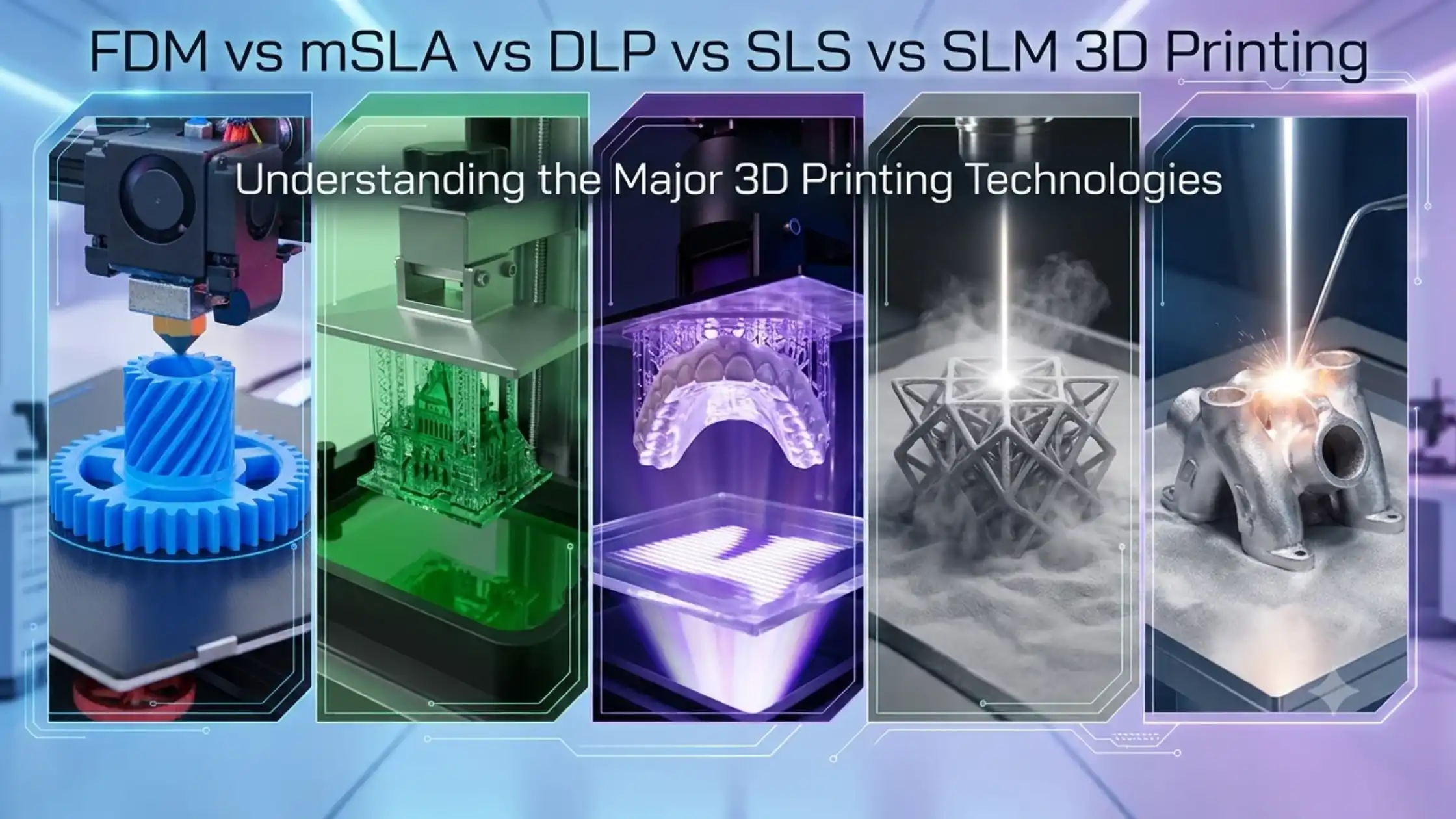
Understanding the Five Major 3D Printing Technologies
The five technologies differ mainly in how they build parts and the materials they process.
FDM: Extrudes thermoplastic filament through a heated nozzle.
mSLA: Uses an LCD mask and light source to cure liquid resin.
DLP: Uses projected light to cure resin.
SLS: Uses a laser to sinter polymer powder.
SLM: Uses a high-energy laser to melt metal powder.
Consequently, each technology suits different applications, from everyday prototypes to specialised industrial components.
1. FDM 3D Printing
Fused Deposition Modelling (FDM) is one of the most accessible 3D printing technologies. It heats thermoplastic filament and deposits it through a nozzle, building the object layer by layer.
Common materials include PLA, PETG, ABS and ASA, depending on the printer's capabilities. FDM works well for concept models, product prototypes, enclosures, fixtures, educational projects and selected functional components.
Its main advantages include broad material choices, practical build volumes and relatively straightforward operation. Moreover, users can often produce parts without the specialised equipment required by industrial printing systems.
However, FDM parts may show visible layer lines, and some designs require support structures. Layer adhesion and print orientation can also influence strength. Therefore, material selection and print settings matter when producing functional parts.
2. mSLA 3D Printing
Masked Stereolithography (mSLA) uses an LCD screen to control how light reaches liquid photopolymer resin. The exposed areas cure into a solid layer, and the printer repeats this process until the model is complete.
Because mSLA can reproduce small features and fine details, it is useful for miniatures, jewellery patterns, dental models and intricate prototypes, depending on the resin and printer.
Its key advantage is the ability to produce detailed models with smooth surfaces. Nevertheless, resin printing requires careful handling, washing and post-curing. Users must also consider resin costs, consumables and practical build-area limitations.
Ultimately, the final part's properties depend on the resin formulation, exposure settings and post-processing. A highly detailed resin model is not automatically suitable for demanding mechanical applications.
3. DLP 3D Printing
Digital Light Processing (DLP) also uses photopolymer resin, but it typically projects a patterned image of light onto the resin to cure each layer.
This process makes DLP useful for applications that require fine features, such as detailed prototypes, dental models and jewellery patterns. Since the system exposes a layer using projected light, its workflow differs from the LCD masking used in mSLA.
Both technologies can deliver impressive detail. However, actual print quality and speed depend on factors such as optical resolution, model geometry, exposure settings and the specific machine.
Like mSLA, DLP requires appropriate resin handling and post-processing. Therefore, compare the complete workflow and the intended application rather than choosing a printer based only on its technology label.
4. SLS 3D Printing
Selective Laser Sintering (SLS) uses a laser to fuse particles within a bed of polymer powder. The machine builds the object layer by layer, while the surrounding unfused powder supports much of the geometry.
Nylon-based materials, including PA12 where supported, are common choices. SLS can produce complex functional prototypes, housings, ducts, brackets and selected low-volume production parts.
One important advantage is the ability to create intricate geometries without relying on dedicated support structures in the same way as many other processes. This can provide flexibility when designing complex components.
On the other hand, SLS systems typically require specialised equipment, powder-handling procedures and finishing. Material and operating costs can also be higher than those of accessible desktop FDM systems. Part strength still depends on the material, design and process conditions.
5. SLM 3D Printing
Selective Laser Melting (SLM) is a metal additive manufacturing process. A high-energy laser melts metal powder to create solid components, building the design layer by layer.
Depending on the system, materials may include stainless steel, titanium alloys and aluminium alloys. Applications include specialised industrial components, tooling and certain aerospace or medical engineering applications.
SLM can produce complex metal geometries and may allow designers to consolidate multiple components into a single part. However, the process requires expensive equipment, specialised safety controls and careful process management.
Parts may also need support removal, heat treatment, machining or inspection. Therefore, metal printing requires application-specific engineering validation. It is a specialised manufacturing process rather than simply a metal version of a desktop filament printer.
FDM vs mSLA vs DLP vs SLS vs SLM: Comparison Table
These are general tendencies, not guaranteed performance rankings. Actual accuracy, strength, finish, production speed and cost depend on the machine, material, geometry and workflow.
Advantages and Limitations of Each Technology
Each process offers a different balance of capabilities.
FDM provides accessible, versatile printing for many everyday projects. In contrast, mSLA and DLP suit applications where fine detail and surface finish matter. SLS supports complex polymer geometries, while SLM serves specialised metal manufacturing requirements.
Nevertheless, no technology wins in every category. Equipment investment, material availability, post-processing, operating costs and part requirements all influence the final choice.
How to Choose the Right 3D Printing Technology
Start by defining what you need the finished part to do. Then compare technologies against your actual requirements.
General prototypes and practical parts: Consider FDM.
Detailed models and smooth resin surfaces: Compare mSLA and DLP.
Complex polymer components: Evaluate SLS.
Specialised metal components: Consider SLM.
Before purchasing equipment, assess material requirements, dimensions, tolerances, expected production volume and post-processing needs. Also consider operator skills, maintenance and total operating costs.
Where possible, evaluate sample parts before investing. This approach helps you compare real-world results instead of relying solely on advertised specifications.
Explore 3D Printing Solutions at 3Idea
For prototyping, maker projects and suitable functional parts, explore 3D printers at 3Idea. You can also evaluate options such as the Bambu Lab P2S Combo for compatible FDM applications.
To choose material for your workflow, browse 3D printing filaments. For resin-based applications, select a compatible printer and resin based on your required detail, material properties and post-processing needs.
Note that SLS and SLM require specialised equipment. Check the current product catalogue to confirm availability before selecting a system for either process.
Frequently Asked Questions
1. What is the main difference between FDM, mSLA, DLP, SLS and SLM?
Ans:- They use different processes: filament extrusion, masked resin curing, projected resin curing, polymer powder sintering and metal powder melting.
2. Which 3D printing technology is best for beginners?
Ans:- FDM is often an accessible starting point, although the best choice depends on your application, material requirements and budget.
3. What is the difference between mSLA and DLP 3D printing?
Ans:- mSLA typically uses an LCD mask to expose resin, while DLP uses a projected light image to cure each layer.
4. Is SLS better than FDM for functional parts?
Ans:- SLS supports complex polymer geometries, but suitability depends on material properties, design, production requirements and total cost.
5. What is the difference between SLS and SLM?
Ans:- SLS commonly sinters polymer powder, whereas SLM melts metal powder to produce metal components.
6. Which 3D printing technology produces the finest details?
Ans:- mSLA and DLP can produce fine details, although results depend on resolution, material, model geometry and printing settings.
Conclusion
The right 3D printing technology depends on your application, material, required detail, performance expectations and budget. Compare these factors before choosing a system, and evaluate sample parts whenever possible.
Explore 3D printers and 3D printing filaments at 3Idea to find options for your next project.
Stay connected with 3Idea through the mobile app: