
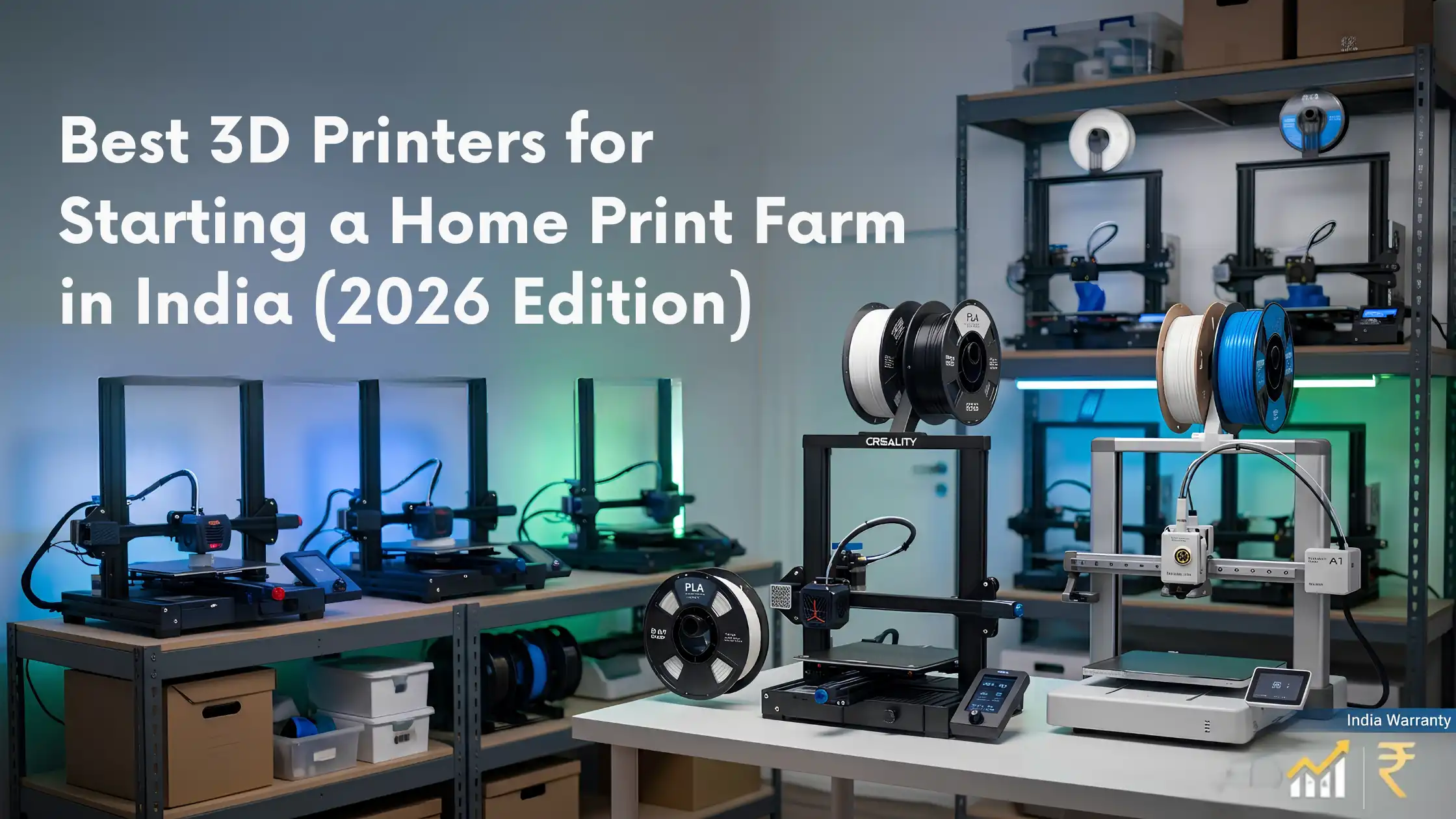
Is a home print farm in India actually profitable in 2026? It is one of the most common questions we hear at 3idea and the honest answer is: yes, if you choose the right printers, target the right niche, and run the operation with basic discipline.
A well-planned home 3D printing business can generate ?50,000–?3,00,000 in monthly profit within 12–24 months. This guide explains exactly how printer selection, real Indian costs, ROI examples, and the scaling roadmap that takes you from a single machine to a profitable small-scale operation.
Quick Answer: Is a Home Print Farm Profitable?
Yes, a home print farm is profitable in India when three conditions are met:
You choose reliable, low-downtime printers
You target a niche with consistent demand and healthy margins
You run the operation as a business, not a hobby
Operators who get all three right routinely deliver 30–50% net margins. Operators who skip any one of them struggle.
The rest of this guide walks through how to get each one right.
Best 3D Printers for a Home Print Farm in India (2026)
Printer choice is the single most important decision. The best machines for an Indian home print farm in 2026:
1. Anycubic Kobra 2 Series
The Kobra 2 Neo and Kobra 3 deliver excellent value for budget print-farm setups. Auto bed levelling, beginner-friendly setup, and reliable print quality at a price point that lets you afford five or six machines for the price of one premium printer.
Best for: beginners, small-batch production, budget farms
Use case: prototyping, custom keychains, hobby items
Price range: ?15,000–?25,000
2. Creality Ender Series (Ender 3 V3 / KE)
Widely used across India for reliability and community support. Easy to maintain, easy to upgrade, with one of the deepest spare-parts ecosystems anywhere. A solid workhorse for continuous production.
Best for: budget setups, learning operators
Use case: continuous production, training new operators
3. Bambu Lab A1 / P1 Series
The Bambu Lab A1 and P1 Series are the workhorses of modern Indian print farms. High print speed, AMS multi-colour, smart cloud monitoring, and remarkable reliability. The price premium pays back in throughput and operator time saved.
Best for: scaling operations, professional workflows
Use case: high-speed production, complex/multi-colour parts
Price range: ?35,000–?1,20,000
4. Elegoo Neptune Series
Solid value for money with stable performance and decent print speed. Suitable for entry-level production setups across multiple materials.
Best for: cost-effective production setups
Use case: entry-level production, mixed material work
5. Snapmaker Artisan / Modular Systems
Snapmaker’s modular machines combine 3D printing, laser engraving, and CNC operations in a single unit. For a multi-service business, print farm + customisation + small CNC work, they offer remarkable flexibility.
Best for: multi-service businesses, premium studios
Use case: custom production, prototyping, multi-process workflows
Price range: ?1,50,000+
All available on 3idea Technology with India warranty and after-sales support. Browse the full range: https://www.3idea.in/products/3d-printers.
Cost Breakdown: Print Farm Setup Cost in India
Realistic investment for an Indian home print farm:
Beginner Setup (1–2 Printers)
Printers (Anycubic Kobra 2 / Creality Ender 3 V3): ?15,000–?40,000 each
Filament starter pack: ?10,000
Workspace (desk, lighting, storage): ?5,000
Software (free): ?0
Total: ?50,000–?1,00,000
Intermediate Setup (5–10 Printers)
Printers (mix of Bambu Lab P1S and Anycubic Kobra): ?1.5L–?4L
Racks, power backup (UPS), ventilation: ?50,000–?1,00,000
Filament stock: ?50,000
Total: ?3L–?6L
Advanced Setup (20+ Printers)
Industrial-grade printer fleet: ?10L+
Automation systems, monitoring software: ?1L+
Dedicated commercial space
Total: ?15L+
These figures reflect 2026 Indian market pricing as available on 3idea. Choose the bracket that matches your starting capital and the demand you’ve already validated.
ROI Example: 3D Printing Business Profit in India
A realistic income model for a single printer:
Print-hours/day: 18 (with overnight runs)
Days/month: 26
Revenue per print-hour (custom-part work): ?70–?130
Gross revenue/printer/month: ?32,000–?60,000
After material (~?6,000), power (~?600), and amortised costs (~?2,000), net profit per machine typically lands at ?20,000–?40,000 per month for steady operations.
For a five-printer home setup, that’s ?1L–?2L monthly net profit. Scale to 10 machines and ?2.5L–?4L is realistic. These numbers depend on niche, pricing discipline, and order flow, but they’re entirely achievable for operators who run the business well.
How to Start a Print Farm at Home (Step by Step)
A practical roadmap:
Choose your niche. Custom keychains, miniatures, engineering prototypes, replacement parts, educational models — pick one with consistent demand in your city or online community.
Buy the right printers. Start with one or two reliable machines (Anycubic Kobra 2 Neo for budget; Bambu Lab A1 for ease of use). Avoid building a multi-printer farm before proving the workflow with one.
Set up the workspace. Stable single-phase power, dry filament storage, good ventilation, and an organised material flow. A spare bedroom or balcony usually works.
Build the workflow. Design intake ? slicing ? printing ? post-processing ? packaging ? despatch. Document each step.
Take your first orders. Friends and family for the first 5–10 prints to debug the workflow. Then launch on Instagram, marketplaces, and local channels.
Reinvest profits. Add the second printer when the first one is consistently fully booked. Don’t scale on credit.
The pattern is the same for every successful operator: prove the workflow first, scale capacity second.
How Many 3D Printers Do You Need?
Match capacity to validated demand. As a rough guide:
1–2 printers: under 50 orders/month, learning phase
5–10 printers: 50–500 orders/month, established small business
20+ printers: 500+ orders/month, commercial operation
Most home-based operations settle at 6–10 printers. Beyond that, you typically need a dedicated commercial space and at least one part-time operator.
Scaling Strategy: From Home to Business
The three-stage progression that works:
Stage 1:- Beginner (1–2 printers)
Prove the niche. Take first 50–100 paid orders. Build a portfolio. Learn what consistent quality looks like.
Stage 2:- Growth (5–10 printers)
Move to a dedicated room in your home or rent a small workshop space. Standardise on consistent material brands. Hire first part-time helper for post-processing. Build recurring B2B clients.
Stage 3:- Advanced (20+ printers)
Move to commercial premises. Hire full-time operators. Implement printer-fleet monitoring software. Consider diversifying into related services — laser engraving, CNC, finishing services.
Each stage funds the next. Skipping stages is the most common reason home print farms fail.
Challenges in Running a 3D Print Farm
Real operational challenges and the standard solutions:
Machine downtime ? preventive maintenance schedule, spare nozzles and PTFE tubes always in stock, daily printer-status check
Material cost creep ? bulk filament purchase agreements, consider 3idea’s in-house filament range for stable supply
Order management complexity ? use a simple Trello board or spreadsheet system early; graduate to dedicated software at 50+ orders/month
Quality drift across machines ? standardise on identical printer models where possible, run weekly calibration print across all machines
Cash flow ? take partial advance payments on custom orders; avoid extending credit to new B2B clients until trust is established
None of these are deal-breakers. They’re the normal mechanics of running a small production business.
How to Increase Profit in a 3D Printing Business
Profit grows from two levers: better margins and higher volume. The highest-leverage moves:
Choose high-margin niches. Custom gifts and personalised products consistently deliver better margins than commodity prototyping.
Optimise print settings for time/cost. A part that prints in 2 hours instead of 3 directly improves machine ROI.
Bulk-buy filament. The 3idea bulk filament programme cuts material cost by 15–25%.
Focus on repeat clients. B2B clients who reorder monthly are worth far more than one-off retail customers.
Add complementary services. Laser engraving, finishing, packaging — bundled services lift average order value.
A 5% improvement in any one of these areas, applied consistently, transforms profitability over a year.
How to Get Orders for Your 3D Printing Business
The channels that work for Indian home print farms:
Instagram:- visual content, behind-the-scenes reels, and customer testimonials drive both B2C and B2B leads
Marketplaces:- JustDial, IndiaMART for B2B; Etsy, Amazon Custom for B2C
Local industrial outreach:- direct contact with local manufacturers, engineering firms, and design houses
Repeat clients:- the biggest single profit driver. One reliable B2B account often delivers more revenue than 50 retail customers
Word of mouth:- quality and delivery reliability are the strongest marketing channels long-term
Consistency wins. A modest output of high-quality reels and posts every week beats sporadic bursts.
Common Mistakes in Starting a Print Farm
The mistakes that hurt operators most:
Buying too many printers too soon. Validate demand first; scale capacity second.
Ignoring maintenance. A neglected printer becomes a non-printing printer fast.
Skipping workflow planning. Improvised processes don’t scale; documented ones do.
Underpricing. Underpricing wins orders but burns through cash.
Spreading too thin across niches. Specialisation drives margin; generalists struggle.
Avoiding these five mistakes is the single biggest improvement most new operators can make.
Conclusion: Start Small, Scale Profitably
A home 3D printing business in India can be highly profitable in 2026 — but only with disciplined execution. The technology, the market, and the supply chain are all in place. What separates successful operators from struggling ones is workflow discipline, niche focus, and patient capital reinvestment.
Start with one or two printers from a reliable brand. Prove the niche. Build the workflow. Then scale gradually as demand justifies it.
Explore the best 3D printers for print farm setups on 3idea Technology: https://www.3idea.in/products/3d-printers
Within 18–24 months, a focused home print farm can become a meaningful small business — generating consistent monthly profit while leaving room to grow.
FAQs
Q. Is a 3D print farm profitable in India?
Ans:- Yes, with the right niche, reliable printers, and consistent operations, Indian print farms regularly deliver 30–50% net margins.
Q. How much investment is needed to start a home print farm?
Ans:- A serious starter setup costs ?50,000–?1,00,000. A small farm (5–10 printers) typically costs ?3–6 lakh.
Q. What is a 3D print farm?
Ans:- A 3D print farm is a setup of multiple 3D printers running in parallel to produce parts at production volume. Typical home farms range from 5 to 20 printers.
Q. How long does it take to recover the investment?
Ans:- Most well-planned home farms break even in 8–18 months, depending on niche, pricing, and operating discipline.
Q. Which 3D printer is best for a beginner print farm in India?
Ans:- The Anycubic Kobra 2 Neo for budget setups and the Bambu Lab A1 for premium starting points. Both are available on 3idea with India warranty.