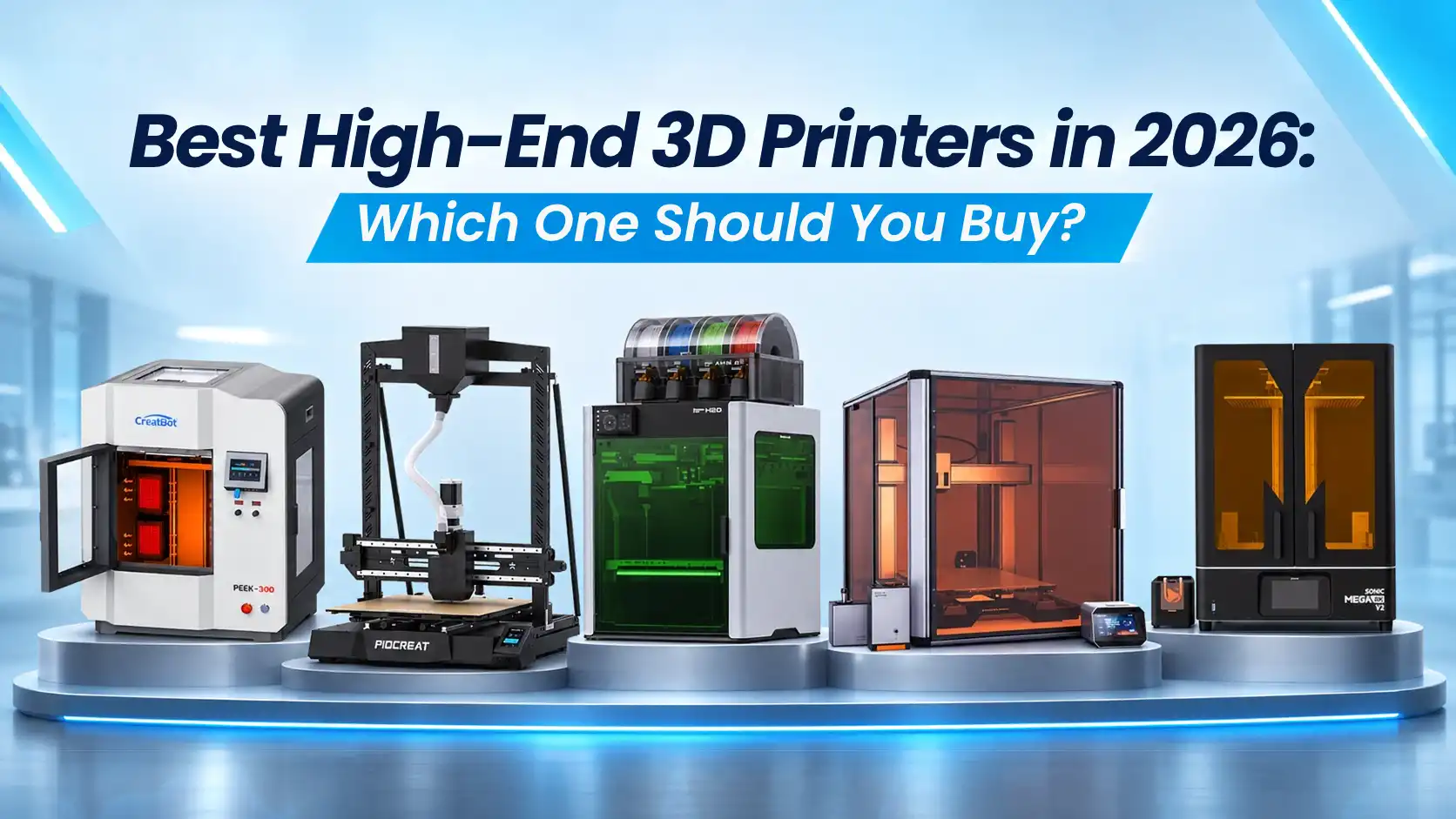
3D printing has moved beyond basic prototyping. Today, businesses, engineers and product designers use advanced machines to develop functional components, manufacture detailed models and explore new production methods. However, choosing the right machine can be challenging because high-end 3D printers serve different purposes. Some specialise in high-temperature engineering materials, while others offer large build volumes, pellet-based printing, multi-function capabilities or detailed resin output. In this guide, we explore five machines worth considering in 2026 and explain which applications they suit best.
What Makes a 3D Printer High-End?
A high-end 3D printer offers capabilities that support demanding applications and professional workflows. However, a higher price alone does not make a machine industrial-grade. Buyers should evaluate its build volume, material compatibility, temperature control, print accuracy and overall reliability.
Additionally, some machines offer features beyond conventional filament printing, such as pellet extrusion, dual-nozzle printing, CNC machining or laser engraving. Therefore, the right choice depends on the materials you use, the size of your designs and the output you expect.
Top 5 Best High-End 3D Printers in 2026
Here are five machines that address different professional and advanced manufacturing requirements.
1. CreatBot PEEK 300 – For High-Temperature Engineering Applications

The CreatBot PEEK 300 is designed for users working with demanding engineering materials, including PEEK. Unlike standard desktop printers, high-temperature systems must maintain suitable processing conditions to handle materials that require specialised extrusion and temperature control.
Consequently, this machine is worth considering for engineering teams, research environments and businesses exploring high-performance polymer components. Before purchasing, check its supported material specifications and processing requirements against your intended application.
Best suited for: High-temperature material printing and specialised engineering applications.
2. Piocreat G5 Ultra – For Large-Format Pellet 3D Printing

The Piocreat G5 Ultra takes a different approach to large-format 3D printing. Instead of relying on conventional filament, it uses Fused Granules Fabrication (FGF) technology, which feeds plastic pellets into a screw-based extrusion system.
It offers a 500 × 500 × 400 mm build volume, a maximum nozzle temperature of up to 420°C and a maximum printing speed of 220 mm/s. Its pellet-based system supports materials such as PLA, ABS, PETG, TPU and selected composite materials, subject to processing requirements.
As a result, the G5 Ultra is worth considering for large prototypes, industrial components, mould-related applications, furniture and product development. Moreover, pellet-based printing can provide an alternative to filament when projects require larger material volumes.
Best suited for: Large-format pellet printing, industrial prototyping and applications requiring pellet-based materials.
3. Bambu Lab H2D Combo 2 40W – For Advanced Multi-Function Workflows

The Bambu Lab H2D Combo 2 40W brings advanced 3D printing and laser functionality into one machine. Its dual-nozzle printing setup supports more versatile printing workflows, while the integrated 40W laser adds another fabrication capability.
As a result, it can appeal to designers, workshops and businesses that want to explore different production methods without relying entirely on separate equipment.
Nevertheless, buyers should evaluate the performance and limitations of each function individually. A multi-function machine offers convenience, but it does not automatically replace every dedicated manufacturing system.
Best suited for: Advanced printing workflows, prototyping and users interested in integrated laser functionality.
4. Snapmaker Artisan 3-in-1 – For Versatile Digital Manufacturing

The Snapmaker Artisan 3-in-1 combines three fabrication methods: 3D printing, CNC machining and laser engraving. Its capabilities include dual-extrusion 3D printing, 200W CNC machining and 10W laser engraving.
This combination makes it an interesting option for workshops, designers and makers who regularly switch between manufacturing processes. For instance, users can print a component, machine a suitable material or create engraved details as part of their broader workflow.
Moreover, combining multiple functions can help save workshop space compared with maintaining separate machines. However, users should assess the working area, supported materials and performance of each module before making a decision.
Best suited for: Workshops and professionals who need 3D printing, CNC machining and laser engraving capabilities.
5. Phrozen Sonic Mega 8K V2 – For Large-Format High-Detail Resin Printing

The Phrozen Sonic Mega 8K V2 is designed for users who need detailed resin prints at a larger scale. It features a 15-inch LCD and 8K resolution, combining a large printing area with the detail associated with MSLA resin technology.
This makes it worth considering for detailed models, prototypes and specialised applications where surface features matter. Furthermore, its large-format design can help users produce bigger resin models without relying on multiple smaller prints.
As with other resin systems, buyers should also account for resin selection, post-processing, ventilation and handling requirements.
Best suited for: Large-format resin printing, detailed models and specialised prototypes.
Which High-End 3D Printer Should You Choose?
The best machine depends on what you want to manufacture. Instead of selecting a printer based only on its specifications, match its capabilities to your actual requirements.
These machines are not direct substitutes for one another. For example, the Piocreat G5 Ultra uses pellet-based FGF technology, while conventional FDM printers use filament. Similarly, a resin printer designed for fine details serves a different purpose from a high-temperature engineering printer. Therefore, identify your primary application before comparing individual specifications.
What Should You Consider Before Buying a High-End 3D Printer?
Before investing in a professional 3D printing machine, consider these five factors:
Application: Decide whether you need functional components, prototypes, detailed models or manufacturing support.
Material compatibility: Check supported materials and whether the machine uses filament, pellets or resin.
Build volume: Choose a printing area that accommodates your typical design dimensions.
Operating costs: Account for materials, maintenance, consumables, electricity and post-processing.
Technical support: Consider installation, training, maintenance and after-sales assistance.
Additionally, review the machine's workflow requirements. A technically capable printer may still be unsuitable if it does not fit your team's space, experience or production needs.
Frequently Asked Questions
1. Which is the best high-end 3D printer in 2026?
Ans:- There is no single best option for every user. The right choice depends on material requirements, build volume, printing technology and intended application.
2. What is the difference between a professional and an industrial 3D printer?
Ans:- Professional printers support advanced design and production workflows, while industrial systems generally address specialised manufacturing requirements, materials, throughput and process controls.
3. What is a pellet 3D printer?
Ans:- A pellet 3D printer uses plastic granules instead of conventional filament. It feeds the material through an extrusion system to create objects layer by layer.
4. What is the Piocreat G5 Ultra used for?
Ans:- The Piocreat G5 Ultra is an FGF pellet 3D printer designed for large-format printing, prototyping, industrial parts, mould-related applications and other pellet-based projects.
5. Should I choose an FDM or resin 3D printer?
Ans:- FDM suits many functional and larger thermoplastic parts, while resin printing is useful for detailed models and applications requiring fine surface features.
6. Are multi-function 3D printers worth buying?
Ans:- They can be useful when a business regularly needs multiple fabrication methods. However, evaluate each function against the performance of dedicated machines.
Conclusion: Choose a 3D Printer That Matches Your Application
The best high-end 3D printer is not necessarily the one with the most features. Instead, choose a machine that matches your materials, project size and production requirements. Whether you need high-temperature printing, pellet-based manufacturing, multi-function fabrication or detailed resin output, understanding these differences will help you make a more informed investment.
Explore the range of professional 3D printing solutions available at 3Idea Technology to find equipment that fits your workflow.
Explore 3Idea on mobile: