
Finding the right pair of shoes is not always easy. Standard shoe sizes follow predefined measurements, but everyone's feet have different shapes, widths and arch structures. As a result, mass-produced footwear may not meet every individual's fitting requirements.
This is where 3D printing in custom footwear is creating new possibilities. By combining 3D foot scanning, digital modelling and flexible materials, manufacturers can develop footwear components that match individual requirements more closely. The technology is also opening new opportunities in custom insoles and orthopedic footwear.
Why Is Custom-Fit and Orthopedic Footwear Important?
Traditional footwear follows standard sizing systems. However, two people wearing the same shoe size may have different foot widths, arch heights and pressure distribution patterns.
For people who need additional foot support, standard footwear may not always provide the required fit. Custom-fit shoes address individual dimensions, while orthopedic footwear is designed around specific functional or clinical requirements.
Personalised designs can help accommodate these differences. However, customisation alone does not guarantee improved comfort or medical benefits. Orthopedic applications should involve appropriate professional assessment.
How Does 3D Printing Create Custom-Fit Shoes?
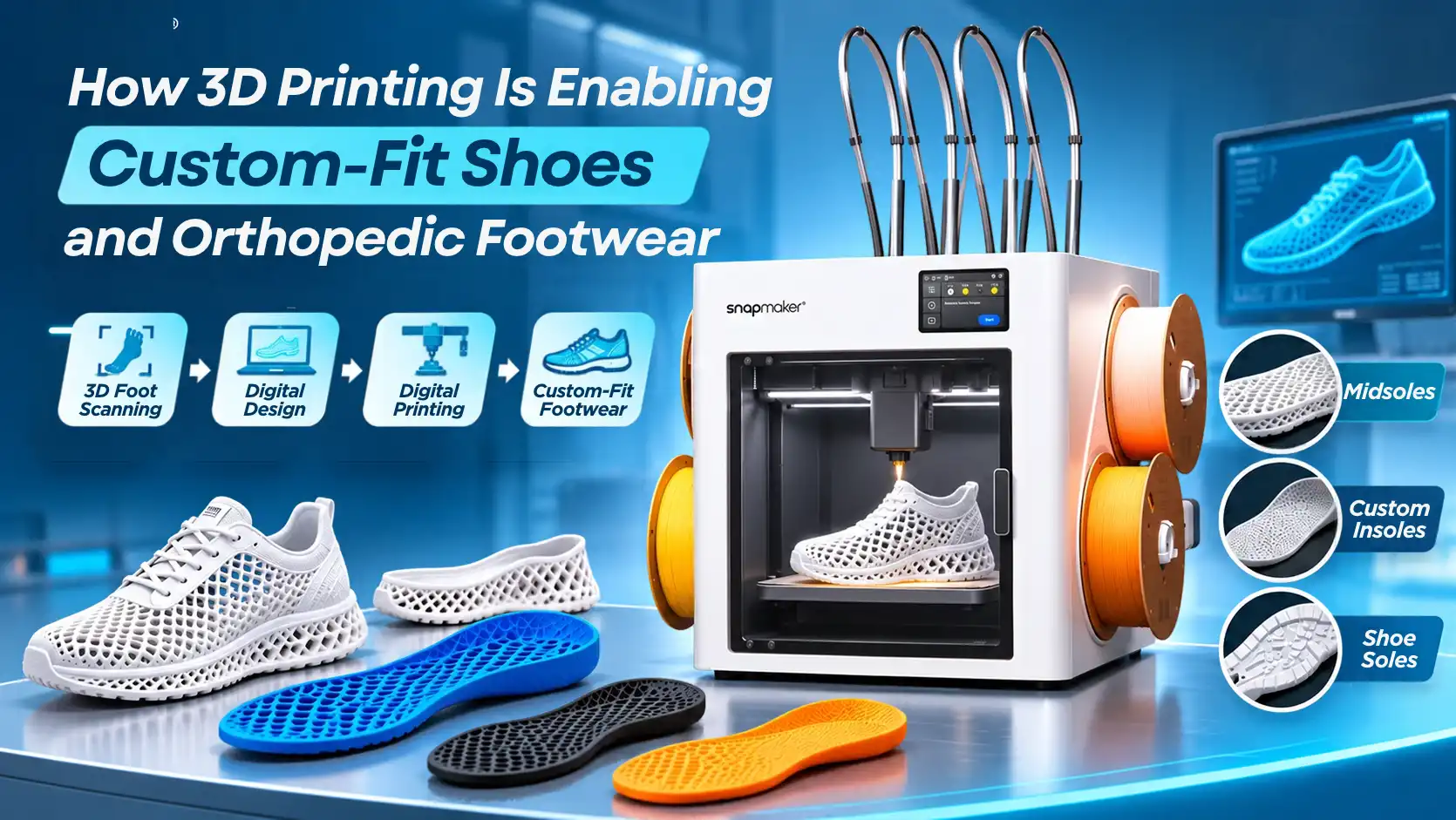
One of the biggest advantages of 3D printing is its ability to translate digital measurements into customised physical components. The process generally involves four stages.
1. Capturing Foot Measurements Through 3D Scanning
The process begins with capturing the shape and dimensions of an individual's foot. A 3D scanner can record its geometry and create a digital representation.
Unlike basic length and width measurements, 3D scanning can capture more detailed surface information. This data provides a useful starting point for designing personalised footwear.
2. Creating a Digital Foot Model
Next, designers use the scan data to create a digital foot model. CAD software helps them examine the geometry and develop footwear components according to the required dimensions.
Designers can adjust the shape, thickness and structure of different components before manufacturing begins.
3. Customising the Footwear Design
The digital design can be modified to accommodate individual fitting requirements. For example, designers can adjust insole geometry, arch areas, cushioning structures and selected shoe components.
They can also incorporate lattice structures, which use repeating patterns to create lightweight designs with different levels of flexibility and support.
4. 3D Printing the Footwear Components
Once the design is ready, suitable components can be produced using an appropriate 3D printing technology and material.
After printing, the components may require cleaning, finishing, assembly and fitting checks. Testing is important because a digital design does not automatically guarantee a comfortable or functional finished product.
How Is 3D Printing Used in Orthopedic Footwear?
3D printing is particularly interesting for applications where footwear needs to accommodate individual foot geometry and specific support requirements.
Custom Orthotic Insoles
Insoles can be designed around an individual's foot shape and relevant clinical requirements. Designers can modify thickness, contours and support zones to create a more personalised structure.
Custom Shoe Components
Manufacturers can produce selected midsoles and other footwear components with customised geometries. For instance, lattice structures can be adjusted to explore different cushioning and flexibility characteristics.
Personalised Orthopedic Shoes
Orthopedic footwear may need to accommodate specific foot dimensions or functional requirements. Digital modelling and 3D printing can support the development of customised components for these applications.
However, medical suitability requires professional assessment. A 3D printed component should not be considered a treatment or corrective solution without appropriate evaluation.
Which 3D Printing Technologies and Materials Are Used?
Different printing technologies support different footwear applications. The selection depends on the component, required flexibility, durability and production requirements.
Among these materials, TPU (Thermoplastic Polyurethane) is particularly relevant to flexible footwear applications. It offers flexibility and elasticity, making suitable grades useful for components that need to bend or compress.
However, not all TPU materials behave the same way. Hardness, elasticity, wear resistance and printer compatibility must be considered before selecting a material.
FDM printers can support prototyping and selected flexible-material applications when their specifications allow it. Meanwhile, SLS technology can produce complex polymer structures using suitable materials and specialised equipment.
Benefits of 3D Printing in Custom Footwear
3D printing offers several possibilities for footwear designers and manufacturers:
Personalised fit: Designs can account for individual foot measurements and geometry.
Greater design flexibility: Designers can modify shapes and structures without creating conventional production tooling for every variation.
Customisable cushioning: Lattice structures can be adjusted to explore different cushioning and flexibility characteristics.
Faster prototyping: Footwear concepts and components can be developed and evaluated digitally and physically.
On-demand production: Selected components can be manufactured according to specific requirements.
Material optimisation: Carefully designed structures may reduce unnecessary material use.
Although these benefits create opportunities for footwear development, the final results still depend on design quality, material selection and testing.
Challenges and Limitations of 3D Printed Orthopedic Footwear
Despite its potential, 3D printing also has limitations. Material durability and long-term wear are important considerations, particularly for components that experience repeated pressure and movement.
Furthermore, printing time and production costs can make large-scale manufacturing challenging. Scanning, CAD design, post-processing and fitting also add steps to the workflow.
Most importantly, footwear must be evaluated for comfort, fit and functional performance. Orthopedic applications require additional professional assessment to ensure that the design meets the individual's needs.
What Is the Future of 3D Printed Custom Footwear?
The future of personalised footwear will likely involve closer integration between digital scanning, design software and additive manufacturing.
More accessible foot-scanning systems, AI-assisted design and customisable lattice structures could make it easier to develop footwear for individual requirements. In addition, on-demand production may support smaller customised batches without relying entirely on conventional mass-production methods.
Although 3D printing is unlikely to replace every traditional footwear manufacturing process, it can provide another way to develop specialised and personalised footwear components. Snapmaker U1 is one such printer which enables users to print 3D Printed Shoes.
Explore 3D Printing and Scanning Solutions at 3Idea
Developing custom footwear involves understanding physical geometry, digital design and suitable materials. 3Idea offers 3D printers, 3D scanners and printing materials from leading brands to support different prototyping and manufacturing requirements.
Explore the best 3D printing and 3D scanning solutions at 3Idea to understand which equipment may suit your application.
Frequently Asked Questions
1. How are custom-fit shoes made using 3D printing?
Ans:- They are developed by scanning foot geometry, creating a digital model, customising the design and printing suitable footwear components.
2. Can 3D printing create orthopedic footwear?
Ans:- Yes. It can produce customised insoles and selected footwear components, subject to professional assessment and validation.
3. Which material is commonly used for 3D printed shoes?
Ans:- TPU and other suitable flexible polymers are relevant materials because of their flexibility and mechanical properties.
4. How does 3D scanning help create custom-fit shoes?
Ans:- It captures foot geometry and provides digital data that designers can use to develop personalised footwear.
5. Are 3D printed orthopedic insoles better than traditional insoles?
Ans:- Not universally. Their suitability depends on individual requirements, design, material and professional assessment.
6. Can FDM 3D printers produce custom footwear?
Ans:- Yes. Compatible FDM printers can produce prototypes and selected footwear components using suitable flexible filaments.
Conclusion
3D printing is creating new opportunities for personalised footwear by combining 3D scanning, digital modelling and flexible materials. From custom-fit insoles to specialised footwear components, the technology allows designers to explore solutions based on individual requirements. As scanning and printing technologies develop, custom footwear could become an increasingly important application of additive manufacturing.
Explore More at 3Idea
If you are exploring personalised footwear development, start by understanding the equipment and materials involved:
Explore 3D Printers at 3Idea – Discover printers for prototyping and suitable flexible-material applications.
Explore 3D Filaments at 3Idea – Browse materials for different 3D printing requirements.
3D Scanners at 3Idea – Explore 3D Scanner for scanning complex designs.
Download the 3Idea App
Explore 3D printers, scanners, materials and accessories through the 3Idea app.