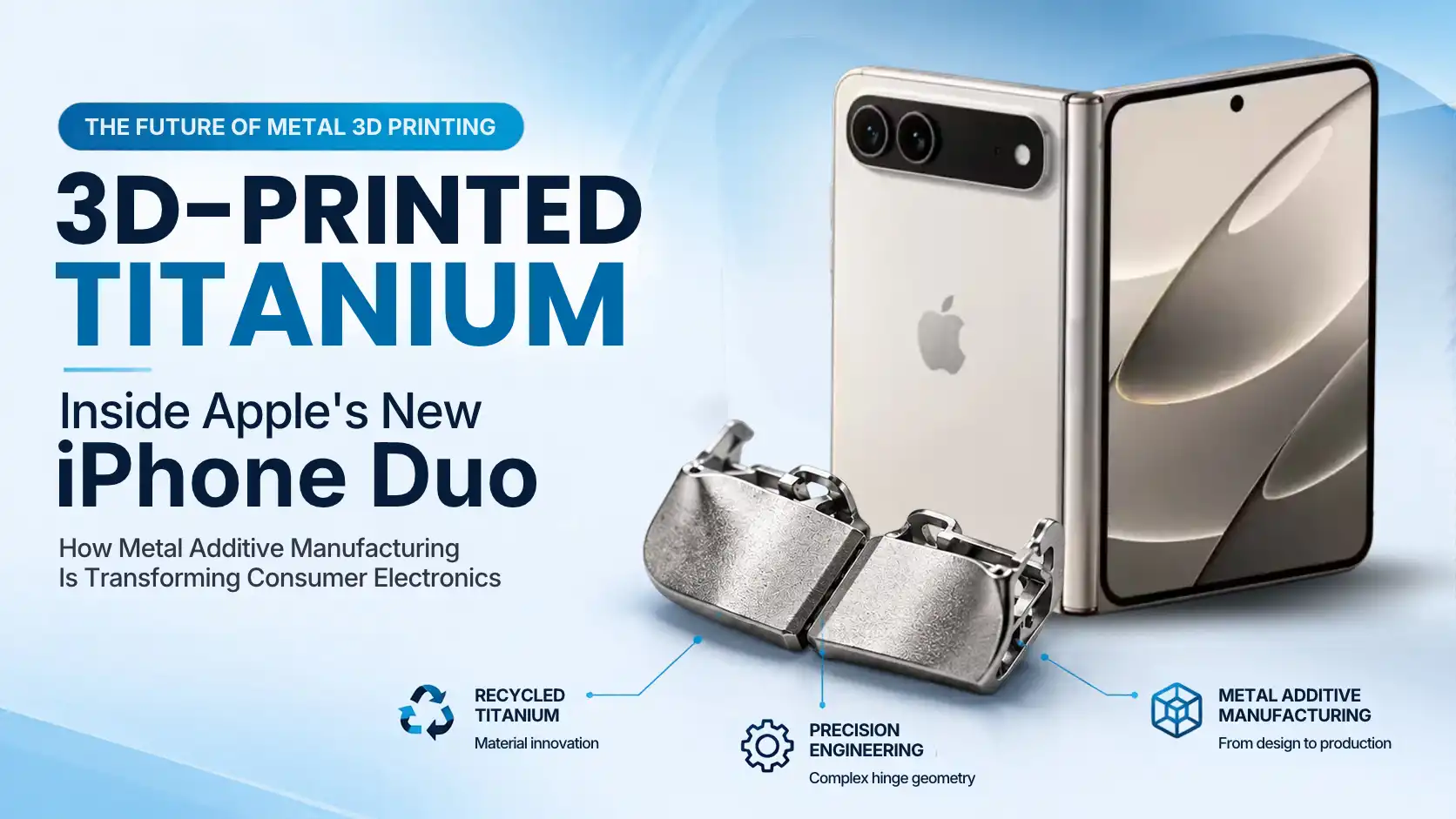
3D printing continues to transform how manufacturers design and produce complex components. A recent example comes from Apple's iPhone Duo, which features a 3D-printed titanium hinge cover. This development highlights how additive manufacturing is moving beyond prototypes into consumer electronics. Moreover, it demonstrates how manufacturers can combine advanced materials, precision engineering and specialised manufacturing processes to create components for compact devices.
Apple's 3D-Printed Hinge Cover: What Makes It Special?
Apple's iPhone Duo features a 3D-printed hinge cover made from 100% recycled titanium. According to Apple's announcement, the cover has a contrasting micro-blasted finish, while the device's titanium enclosure features a mirror-polished finish.
The hinge assembly itself contains more than 100 components, which work together to control opening and closing while supporting the folding display. This makes precision particularly important because even small variations can affect component alignment and movement.
The interesting part is that Apple has used 3D printing for a component within a mainstream consumer device. However, Apple has not publicly identified the exact metal 3D printing process used to manufacture this hinge cover.
How Does Metal 3D Printing Work?
Understanding Metal Additive Manufacturing
Metal 3D printing, also known as metal additive manufacturing, produces components by building material layer by layer from a digital design. Unlike conventional machining, which removes material from a solid block, additive manufacturing deposits or fuses material only where the design requires it.
This approach gives engineers greater flexibility when developing intricate geometries, internal features and specialised components. Furthermore, manufacturers can create certain designs that may be difficult or expensive to produce using conventional manufacturing methods.
What Is Laser Powder Bed Fusion?
Laser Powder Bed Fusion (LPBF) is one of the widely used metal additive manufacturing processes.
It works through a series of steps:
A thin layer of metal powder spreads across a build platform.
A high-energy laser selectively melts the required areas.
The platform moves down, allowing another powder layer to form.
The laser repeats the process until the component takes shape.
The finished part undergoes powder removal and post-processing.
LPBF is an important technology for producing complex metal components. However, it is an example of metal 3D printing, not a confirmed description of Apple's manufacturing process for the iPhone Duo hinge cover.
Why Combine Titanium with 3D Printing?
Titanium is widely used in demanding engineering applications because of its strength-to-weight characteristics and corrosion resistance. Consequently, it can be useful when manufacturers need strong, carefully engineered components without relying on heavier materials.
3D printing adds another advantage: design flexibility. Engineers can develop intricate geometries and manufacture components according to specific design requirements. This can be particularly valuable in compact devices, where space, alignment and component integration matter.
Apple also identifies 100% recycled titanium in the iPhone Duo's 3D-printed hinge cover. This highlights how material selection and manufacturing methods can contribute to product design and sustainability goals. Nevertheless, the environmental impact of a component also depends on energy use, material processing and the wider production supply chain.
Precision Scanning and Advanced Surface Finishing
Metal 3D printing is only one part of advanced component manufacturing. Inspection, alignment and surface finishing also play important roles in achieving consistent results.
Confocal Laser Scanning
TechCrunch reported that Apple described using a confocal laser to scan the topology of individual hinge units. This technique helps capture surface variations and identify deviations that may affect component alignment.
Photopolymer Micro-Layer Printing
Apple's hardware presentation also described using a process that 3D-prints up to 25 micro-layers of a custom photopolymer to address residual surface waviness.
Importantly, this is a separate photopolymer process. It should not be confused with the 3D printing of the titanium hinge cover.
AI-Assisted Component Matching
Apple also described using AI algorithms to match each hinge with a suitable housing. This helps achieve precise alignment between individual components.
Together, these steps demonstrate how additive manufacturing, optical inspection and automated matching can contribute to precision engineering.
Benefits of 3D Printing in Consumer Electronics
The iPhone Duo example highlights several ways additive manufacturing can support consumer electronics production.
Design flexibility: Engineers can explore complex shapes and component geometries.
Precision engineering: Manufacturers can produce parts designed around specific dimensional requirements.
Material efficiency: Additive manufacturing can reduce some material waste compared with processes that remove material from solid blocks.
Component integration: It can create opportunities to combine certain design features and simplify assembly.
Product innovation: Designers can test and manufacture components that may be challenging to produce through conventional methods.
However, these benefits depend on the material, component design, production volume and manufacturing process. 3D printing does not automatically make every component cheaper, lighter or stronger.
Applications of 3D Printing Beyond Smartphones
The applications of 3D printing extend well beyond consumer electronics.
Automotive: Manufacturers use 3D printing for prototypes, specialised brackets, tooling and selected functional components.
Aerospace: Engineers produce complex metal components where weight and design requirements are important.
Medical: 3D printing supports customised implants, surgical models and specialised medical components.
Industrial manufacturing: Businesses create machine components, fixtures, jigs and customised tooling.
Consumer electronics: Manufacturers can explore specialised housings, mechanical components and product prototypes.
As materials and manufacturing capabilities develop, additive manufacturing continues to create opportunities across different industries.
Traditional Manufacturing vs 3D Printing
Both approaches have important roles in modern manufacturing. The right choice depends on production volume, material requirements, component complexity, cost and quality standards.
Limitations and Challenges of Metal 3D Printing
Despite its advantages, metal 3D printing also presents challenges. Industrial equipment and specialised metal powders can involve significant investment. Additionally, manufacturers must manage powder handling, process consistency and material quality.
Finished components may also require heat treatment, machining, polishing or other post-processing. Therefore, manufacturers must evaluate the complete production workflow rather than considering the printing stage alone.
What Apple's Innovation Means for the Future of 3D Printing
Apple's use of a 3D-printed titanium component in a consumer device highlights the growing relevance of additive manufacturing in precision engineering. As materials, equipment and quality-control methods advance, manufacturers can explore more complex component designs and specialised production applications.
Explore 3D Printing Solutions at 3Idea
From FDM 3D printers for prototyping to 3D scanners for capturing physical objects, 3Idea offers solutions for designers, engineers and businesses exploring additive manufacturing. You can also explore different 3D printing materials for developing models and prototypes.
Frequently Asked Questions
1. Is the Apple iPhone Duo hinge 3D printed?
Ans:- Apple confirms that the iPhone Duo features a 3D-printed titanium hinge cover.
2. What material is used in Apple's 3D-printed hinge cover?
Ans:- Apple states that the hinge cover uses 100% recycled titanium.
3. Which 3D printing technology does Apple use for the hinge cover?
Ans:- Apple has not publicly confirmed the exact metal 3D printing process.
4. What is Laser Powder Bed Fusion?
Ans:- LPBF uses a laser to selectively melt metal powder layer by layer to produce components.
5. Why is titanium used in 3D printing?
Ans:- Titanium offers useful strength-to-weight characteristics and corrosion resistance for demanding engineering applications.
6. Can 3D printing manufacture smartphone components?
Ans:- Yes. Additive manufacturing can produce specialised housings, mechanical parts and intricate components for consumer electronics.
Conclusion
Apple's 3D-printed titanium hinge cover demonstrates how additive manufacturing can contribute to advanced consumer electronics. From precision components to industrial applications, 3D printing continues to expand manufacturing possibilities.
Explore 3Idea's product range:
Download the 3Idea App: Android – Google Play Store | iOS – App Store