
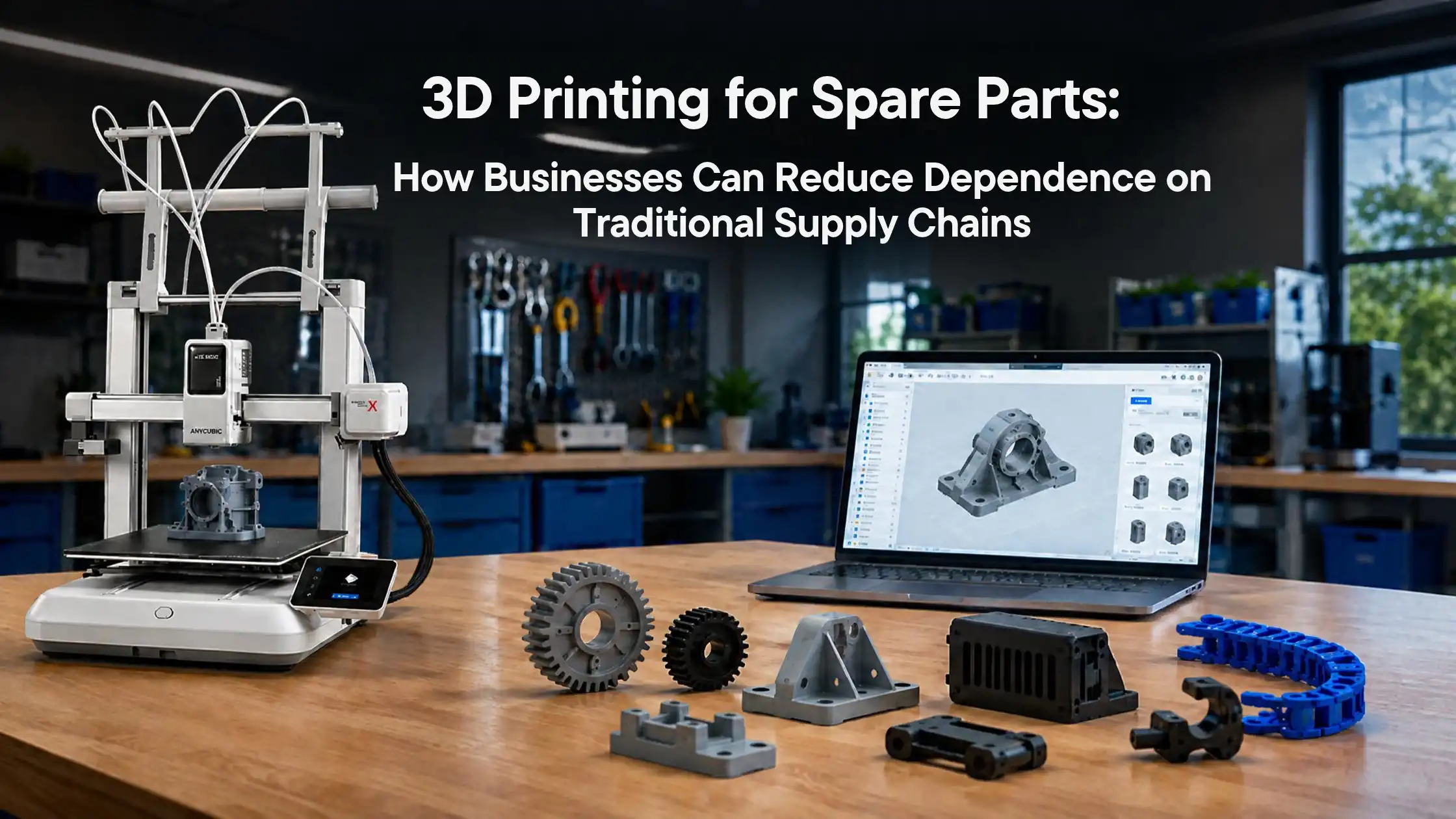
Businesses often depend on spare parts to keep machinery, production lines and equipment running smoothly. However, delayed shipments, discontinued components and limited supplier availability can turn a small maintenance issue into an expensive operational problem. 3D printing for spare parts offers an alternative for producing selected replacement components on demand. By combining digital models with suitable materials and reliable printing processes, businesses can reduce their dependence on physical inventory and traditional procurement for certain applications.
Why Spare Parts Supply Chains Can Become a Business Bottleneck
Traditional spare-parts procurement works well when suppliers have stock and deliveries arrive on time. However, businesses can face challenges when components come from overseas, manufacturers discontinue older models or suppliers require large minimum orders.
Consequently, a missing bracket, cover or machine housing can delay maintenance and interrupt operations. Businesses may respond by storing extra components, tying up capital in inventory that might not be used for months.
For manufacturers and maintenance teams, the challenge is finding a practical way to access suitable replacement parts without relying entirely on conventional sourcing.
How 3D Printing Helps Businesses Produce Spare Parts on Demand
3D printing, also known as additive manufacturing, builds an object layer by layer from a digital model. Instead of ordering every component from a supplier, a business can assess whether it can manufacture selected plastic parts internally.
The process generally follows five steps:
Identify the part: Determine the component's function, dimensions and operating conditions.
Create a digital model: Use an existing CAD file, measurements or reverse engineering to prepare the design.
Select the material: Choose a suitable filament or resin based on strength, temperature, wear and other requirements.
Print the component: Prepare the model using slicing software and manufacture it on a compatible 3D printer.
Inspect and validate: Check dimensions, fit and performance before putting the component into service.
Once a business validates the model and printing process, it can store the digital file for future production. This creates a digital spare-parts library that complements physical inventory.
Key Benefits of 3D Printing for Spare Parts
1. Reduce Lead Times for Suitable Parts
When a required component is unavailable locally, purchasing it may involve supplier coordination, manufacturing schedules and shipping delays. On-demand printing can provide another option when the part is printable and its digital model is ready.
For example, a factory may need a replacement plastic guide for a non-critical machine assembly. If the component meets the printer's material and performance requirements, local production could help the maintenance team avoid waiting for a conventional order.
2. Reduce Dependence on Physical Inventory
Businesses do not always need to store every low-demand component physically. Instead, they can maintain digital files for suitable parts and manufacture them when required.
However, this approach works best when printing and validation can finish within an acceptable timeframe. Frequently used or critical components may still require physical stock.
3. Support Obsolete and Hard-to-Find Components
Older equipment can become difficult to maintain when manufacturers discontinue specific plastic components. In some cases, engineers can recreate a replacement using measurements, an existing part or 3D scanning.
Nevertheless, reproducing the shape does not automatically reproduce the original material properties or performance. Businesses must evaluate and test the redesigned component before use.
4. Support Low-Volume Production
Traditional manufacturing can involve tooling costs, minimum order quantities and supplier setup requirements. For selected customised or low-volume components, 3D printing can reduce the need for dedicated tooling.
The actual financial benefit depends on material consumption, machine time, labour, finishing, failed prints and inspection requirements.
Which Spare Parts Can Be 3D Printed?
FDM 3D printing is a practical starting point for evaluating many plastic replacement components. Suitable examples may include:
Protective covers, caps, knobs and housings
Brackets, clips, guides and cable-management components
Custom jigs, fixtures and maintenance aids
Selected low-load machine components
Certain obsolete or low-volume plastic parts
Resin 3D printing can also produce smaller components that require fine detail, depending on the resin's mechanical properties and the application's demands.
However, part suitability depends on more than appearance. Engineers must consider mechanical loads, heat exposure, chemical contact, wear, dimensional accuracy and the consequences of failure.
Choosing the Right Material for Spare Parts
The right material depends on the component's operating environment and required performance.
PLA: Suitable for prototypes and selected low-stress components where operating conditions permit.
PETG: Worth evaluating for functional plastic parts that need a balance of toughness and ease of printing.
ABS and ASA: May suit applications requiring greater temperature resistance, subject to the material grade and operating conditions.
Nylon and reinforced engineering filaments: Potential options for more demanding applications when the printer, material and process support them.
Importantly, a material's name alone does not establish whether a printed part is fit for service. Businesses should test the finished component under representative conditions and follow appropriate engineering requirements.
When Is 3D Printing Not the Right Choice?
3D printing does not replace every traditional manufacturing method. Conventional sourcing or production may remain more suitable for high-volume components, very tight tolerances, demanding wear conditions or parts requiring certified material properties.
Similarly, businesses should not replace safety-critical, pressure-bearing or highly loaded components simply because a printer can reproduce their shape. These applications require appropriate engineering assessment, qualification and validation.
The objective is to identify where additive manufacturing provides a useful alternative—not to force every spare part into a 3D printing workflow.
How Businesses Can Start Using 3D Printing for Spare Parts
Businesses can begin with a small, controlled evaluation rather than investing in a large-scale spare-parts programme immediately.
Identify recurring problems: List components with long lead times, repeated availability issues or costly minimum orders.
Assess printability: Review the part's geometry, dimensions, operating conditions and material requirements.
Produce and test a sample: Manufacture a trial component and compare it against defined acceptance criteria.
Compare the results: Evaluate production cost, lead time, reliability and the impact on maintenance operations.
To calculate the actual cost per printed part, include material, machine time, labour, post-processing, inspection and expected print failures. Compare this with the full cost of traditional sourcing, including shipping, tooling, inventory holding and the operational impact of waiting.
Choosing a 3D Printer for Spare-Parts Production
Before selecting a printer, businesses should evaluate build volume, compatible materials, dimensional repeatability, reliability, enclosure requirements, maintenance and expected machine utilisation.
Here are three 3Idea printer options worth evaluating for different FDM workflows:
Bambu Lab X2D Combo 3D Printer: Consider it when evaluating compatible engineering-material workflows and applications that may benefit from active chamber heating and a dual-nozzle system.
Bambu Lab P2S Combo 3D Printer: Worth considering for general-purpose prototyping, fixtures and suitable functional components.
Snapmaker U1 3D Printer: Its four-toolhead configuration offers an option for exploring compatible multi-material and support-material workflows.
These printers serve as starting points for evaluation, not universal solutions for industrial replacement parts. Always verify material compatibility and component requirements before selecting equipment.
Frequently Asked Questions
1. How can 3D printing reduce spare-parts lead times?
Ans:- It can enable local production of suitable replacement components, reducing dependence on supplier stock and shipping schedules.
2. Can 3D printing replace traditional spare-parts supply chains?
Ans:- It can complement traditional procurement for selected parts, while conventional sourcing remains important for high-volume and specialised components.
3. Which spare parts can be made using FDM 3D printing?
Ans:- Suitable examples include covers, brackets, clips, housings, jigs and selected low-load plastic components.
4. Can 3D printing help businesses reduce spare-parts inventory?
Ans:- Yes, a digital inventory can complement physical stock for suitable, infrequently needed parts when production time is acceptable.
5. Which material is best for 3D printed spare parts?
Ans:- The best material depends on the application's strength, temperature, wear, chemical exposure and dimensional requirements.
6. Is 3D printing spare parts cost-effective for businesses?
Ans:- It can be economical for selected low-volume or hard-to-source parts, but businesses should compare total costs with traditional sourcing.
Conclusion: Build a More Flexible Spare-Parts Strategy
3D printing for spare parts gives businesses another way to address selected procurement delays, obsolete components and inventory challenges. By starting with suitable parts, validating performance and comparing total costs, organisations can determine where on-demand manufacturing fits into their existing supply chains.
Explore 3Idea's 3D Printing Solutions
Businesses looking to evaluate on-demand production can explore the following categories and products:
FDM 3D printers: Explore 3D printers at 3Idea
3D printing materials: Explore 3D Filaments at 3Idea
Related spare parts and accessories: Explore Spare Parts and Accessories used in 3D Printer and Machines.
Recommended printers: Bambu Lab X2D Combo | Bambu Lab P2S Combo
Get the 3Idea App
Explore 3D printers, filaments, scanners, spare parts and other digital manufacturing solutions through the 3Idea app.