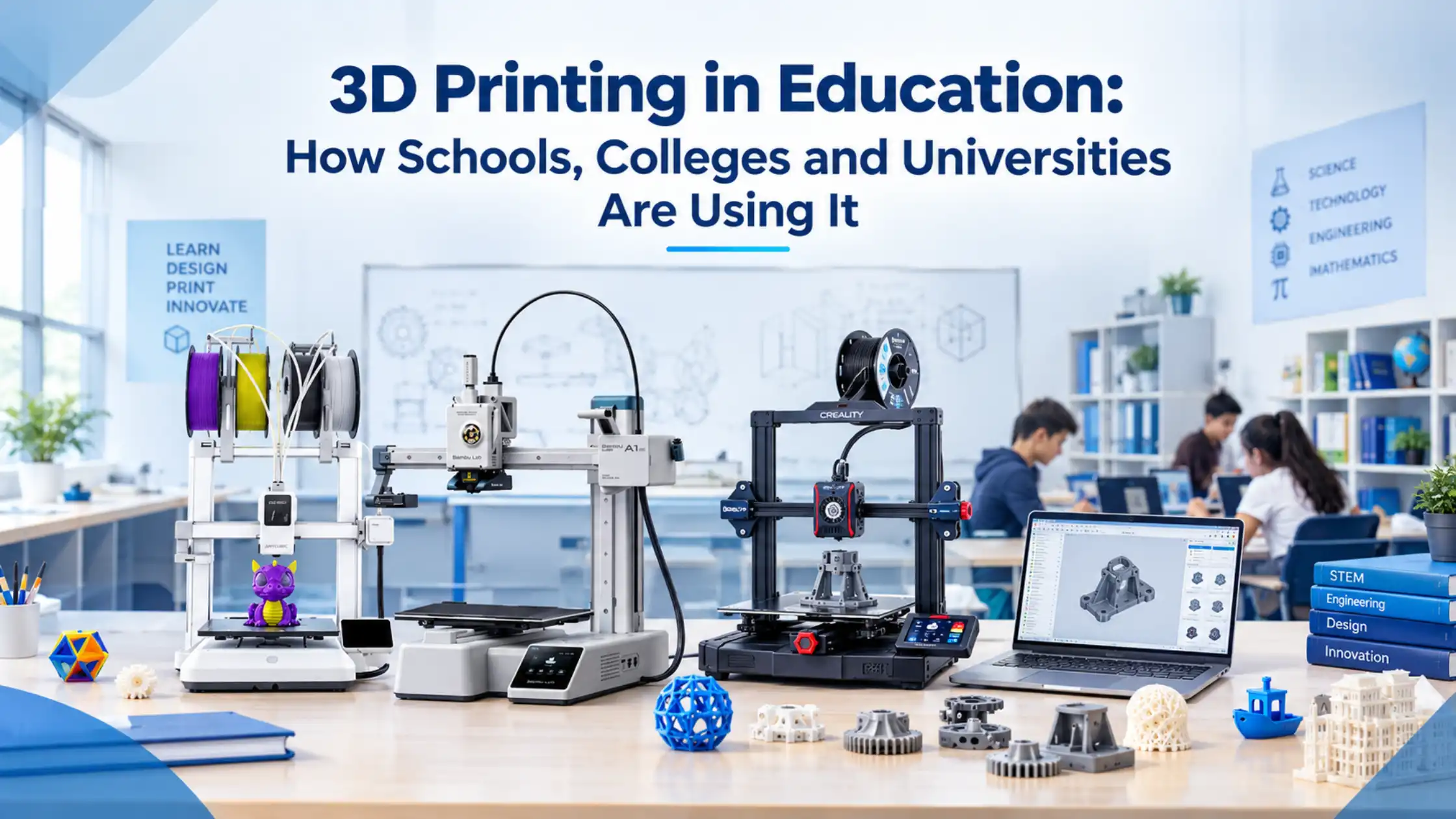
Education becomes more engaging when students can turn what they learn in textbooks into something they can see, touch and test. That is where 3D printing in education can make a difference. By converting digital designs into physical objects, 3D printers help students explore scientific concepts, develop engineering skills and experiment with their own ideas.
Across schools, colleges and universities, educators can use this technology to introduce practical learning alongside traditional teaching. From geometric models in school classrooms to functional prototypes in engineering laboratories, 3D printing creates opportunities to learn through experimentation.
Why Is 3D Printing Becoming Relevant in Education?
Many subjects involve concepts that students find difficult to visualise. For example, a textbook can explain a molecular structure, mechanical assembly or geographical formation, but a physical model offers another way to understand its shape and relationships.
Moreover, 3D printing supports project-based learning. Students can design an object, print it, evaluate the result and improve the design. This process encourages problem-solving, creativity and critical thinking.
It also connects several disciplines. A single project might involve science, mathematics, computer-aided design (CAD) and engineering. However, successful implementation depends on suitable lesson plans, teacher guidance and realistic project goals—not simply installing a printer in the classroom.
How Schools, Colleges and Universities Use 3D Printing
1. 3D Printing in Schools
Schools can introduce 3D printing through simple, curriculum-linked activities. Teachers can print geometric solids to explain volume and surface area, topographic models to demonstrate landforms, or molecular structures to support science lessons.
Students can also design nameplates, simple mechanisms, miniature bridges and other STEM project models. As a result, they begin to understand how digital designs become physical objects.
For younger learners, teachers should choose age-appropriate software, manageable projects and supervised printing activities. This helps students focus on learning without becoming overwhelmed by technical complexity.
2. 3D Printing in Colleges
Colleges can use 3D printing for engineering assignments, product design, robotics and innovation projects. For instance, students can develop a component in CAD software, print a prototype and check whether its dimensions and assembly work as intended.
Design students can explore product shapes and ergonomics, while mechanical engineering students can create demonstration models of gears, brackets and mechanical systems.
Furthermore, affordable prototyping allows students to test different design iterations before finalising a project. They can learn from unsuccessful prints, identify design problems and make improvements.
3. 3D Printing in Universities
Universities can extend these applications into research and specialised laboratory work. Researchers and students may use printed models for architectural visualisation, engineering experiments, scientific demonstrations and selected anatomical teaching applications.
In product development, teams can produce concept models before investing in more expensive manufacturing processes. Similarly, research groups can use custom-designed fixtures and experimental components when appropriate.
The exact application depends on the department, research objective, material requirements and validation process.
Key Benefits of 3D Printing in Education
Better visual understanding: Physical models help students examine complex shapes and spatial relationships from different angles.
Practical design skills: Students gain experience with CAD modelling, design adjustments and the transition from a digital file to a physical object.
Creativity and experimentation: Learners can test different designs, identify mistakes and improve their work through repeated iterations.
Interdisciplinary learning: Projects can combine mathematics, science, engineering, art and technology, encouraging students to approach problems from different perspectives.
Nevertheless, institutions should plan for teacher training, material consumption, maintenance and printing time. These practical requirements help ensure that the technology supports the curriculum effectively.
FDM vs Resin 3D Printing for Education
Choosing the right printing technology depends on what students need to create.
FDM 3D Printing
Fused Deposition Modelling (FDM) printers build objects by depositing melted filament in layers. They are a practical starting point for many educational institutions because they support general models, prototypes, classroom demonstrations and selected functional projects.
Common materials include PLA and PETG, although suitability depends on the intended application. FDM printers can support a wide range of school STEM activities and college engineering assignments.
Resin 3D Printing
Resin printers use light to cure liquid photopolymer resin. They can produce highly detailed models, making them useful for selected specialist applications, intricate designs and detailed visualisation.
However, resin printing requires additional precautions. Institutions must establish appropriate procedures for resin handling, protective equipment, ventilation where required, washing, curing and waste disposal.
For general classroom use, FDM is often a sensible starting point. Resin printing may be more appropriate for supervised specialist labs with the necessary safety procedures.
How to Choose a 3D Printer for Educational Institutions
Before purchasing equipment, schools and colleges should consider the following factors:
Student age and supervision: Choose a workflow that teachers and students can manage safely.
Ease of use: Features such as automatic calibration can simplify routine setup.
Build volume: Match the printer's working area to the size of the models students will create.
Material compatibility: Select materials that suit the curriculum and intended projects.
Expected workload: Consider the number of students, printing frequency and availability of lab time.
Total ownership cost: Account for the printer, filament or resin, maintenance, training and replacement parts.
Technical support: Reliable guidance can help institutions manage troubleshooting and routine upkeep.
A smaller printer may suit a classroom with limited space, while a larger or more capable machine may be appropriate for a dedicated engineering lab.
3D Printers to Consider for Educational Use
3Idea offers several FDM printers that institutions can evaluate according to their students' needs and project requirements.
Creality Ender-3 V3 SE 3D Printer:- This printer is worth considering for introductory maker activities, basic STEM models and student-designed objects. Its automatic levelling features and PLA printing support can suit entry-level workflows.
Bambu Lab A1 Mini 3D Printer:- Its compact size and automated calibration features make it worth evaluating for smaller classrooms, project spaces and institutions with limited lab space.
Anycubic Kobra X 3D Printer:- Its multicolour printing capability can support visual demonstrations, colour-coded models and creative student projects where different colours help communicate design details.
These are examples to evaluate rather than universally suitable classroom choices. Institutions should check the specifications, operating requirements, material compatibility and supervision needs before selecting a model.
How Institutions Can Get Started With 3D Printing
Schools, colleges and universities do not need to introduce 3D printing across every department immediately. Instead, they can start with one manageable project and expand gradually.
Choose a learning objective: Select a project that supports a specific lesson, assignment or research activity.
Introduce beginner-friendly software: Teach students how to create or modify a basic 3D model.
Train a teacher or lab supervisor: Establish responsibility for printer operation, maintenance and safety.
Create printing guidelines: Define material handling, equipment use and supervision procedures.
Review the results: Evaluate student participation, print quality, time requirements and running costs before expanding the programme.
This approach helps institutions understand the practical requirements before investing in additional equipment.
Frequently Asked Questions
1. How is 3D printing used in education?
Ans:- Educators use 3D printing to create physical learning models, engineering prototypes, scientific demonstrations and student-designed projects.
2. What are the benefits of 3D printing for students?
Ans:- It supports hands-on learning, spatial understanding, creativity, problem-solving and practical experience with digital design.
3. How can schools use 3D printing in STEM education?
Ans:- Schools can print geometry models, molecular structures, topographic maps, simple mechanisms and objects designed for STEM projects.
4. Which type of 3D printer is suitable for schools?
Ans:- FDM printers are a practical starting point for many schools because they support common educational models and filament-based projects.
5. Is FDM or resin 3D printing better for education?
Ans:- FDM often suits general classroom projects, while resin printing can serve detailed specialist applications with appropriate safety procedures.
6. What should a school consider before setting up a 3D printing lab?
Ans:- Schools should evaluate the curriculum, printer suitability, student supervision, safety, materials, teacher training, maintenance and total running costs.
Conclusion: Bring Practical Learning Into the Classroom With 3D Printing
3D printing in education gives students opportunities to turn ideas into physical models, test designs and explore concepts through practical activities. From school STEM projects to university research, the technology can support learning when institutions align it with clear educational objectives.
The best starting point is to identify the projects students need to complete and select equipment that fits the curriculum, available space, supervision requirements and budget.
Explore 3Idea's 3D Printing Solutions
Schools, colleges and universities can explore these categories and products to identify equipment for their learning environments:
3D printer category: Explore 3D printers at 3Idea
Entry-level educational projects: Creality Ender-3 V3 SE
Compact classroom projects: Bambu Lab A1 Mini
Multicolour educational models: Anycubic Kobra X
Get the 3Idea App
Explore 3D printers, filaments, accessories and other digital manufacturing solutions through 3Idea.
Publishing note: Replace the Android placeholder with the verified Google Play Store listing. Confirm that the iOS link resolves to the intended 3Idea app before publishing.