
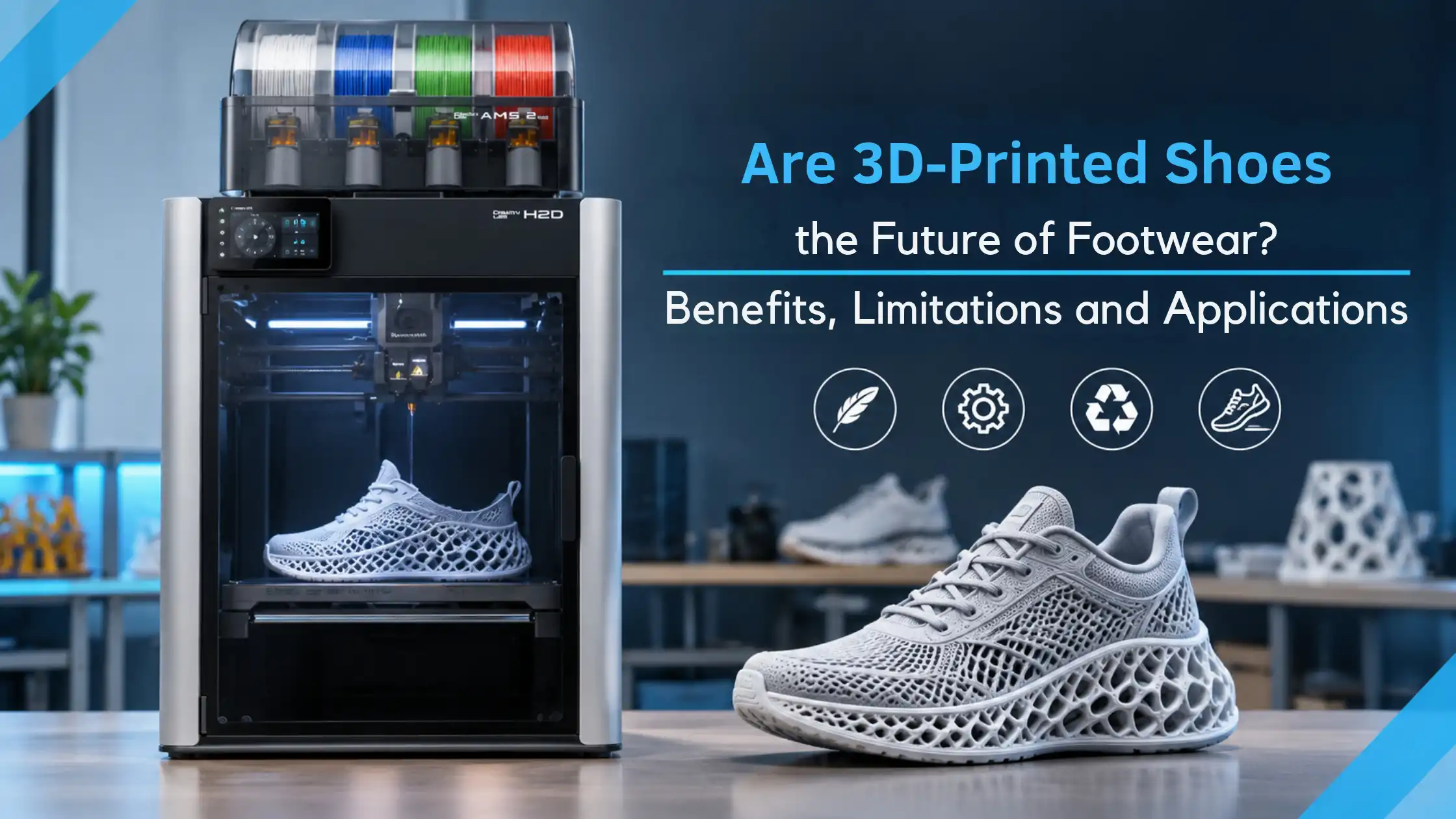
The footwear industry is exploring new ways to combine comfort, performance and design. One technology attracting attention is 3D-printed shoes. Instead of relying entirely on conventional manufacturing methods, designers can use 3D printing to create customised shapes, flexible structures and intricate sole patterns. From lightweight midsoles to personalised insoles, additive manufacturing is opening up new design possibilities. But can this technology become a mainstream method of footwear production? Let's explore how it works, where it is useful and what challenges remain.
How Are 3D-Printed Shoes Made?
The process begins with a digital design created using computer-aided design (CAD) software. Designers develop a 3D model of the shoe, sole, midsole or another component according to its intended use.
Next, they select a suitable material and prepare the model for printing. A compatible 3D printer then builds the component layer by layer. Depending on the design, manufacturers may print an entire shoe as one structure or produce individual parts that are later assembled with conventional materials.
Finally, the printed components undergo finishing and quality checks. Manufacturers evaluate factors such as flexibility, fit, durability and comfort before considering the footwear ready for use.
Technologies Used in 3D-Printed Footwear
Different 3D printing technologies support different footwear applications. The right process depends on the material, design complexity and performance requirements.
1. FDM 3D Printing
Fused Deposition Modelling (FDM) works by melting and extruding thermoplastic filament through a heated nozzle. It is useful for footwear prototypes and selected flexible components made with materials such as TPU. Designers can also use FDM printers to test sole patterns and explore different shapes before finalising a design.
2. SLS 3D Printing
Selective Laser Sintering (SLS) uses a laser to fuse polymer powder into solid objects. This process can produce complex geometries, including intricate lattice structures. It is particularly relevant to specialised footwear components where design freedom and complex internal structures matter.
3. Resin-Based 3D Printing
Resin-based technologies use light to cure liquid photopolymer resin into solid layers. Specialised flexible photopolymers can support certain footwear prototypes and components. However, ordinary rigid resin is not suitable for every footwear application, especially where repeated bending and flexibility are essential.
Materials Used in 3D-Printed Shoes
Material selection plays an important role in footwear performance. A shoe needs to balance flexibility, cushioning, durability and comfort.
TPU (Thermoplastic Polyurethane)
TPU is a flexible thermoplastic used in various 3D printing applications. Its elasticity and flexibility make it relevant to shoe soles, midsoles and other components that need to bend or compress. However, the final performance depends on the TPU formulation, printed structure and intended application.
Flexible Polymers and Elastomers
Other flexible polymers and elastomer-like materials offer different levels of softness, resilience and flexibility. Designers select them according to the requirements of the shoe component.
Other Specialised Materials
Industrial footwear workflows may also use polymer powders and specialised photopolymers. Therefore, the best material depends not only on flexibility but also on the printing technology, expected wear and required cushioning.
Benefits of 3D-Printed Shoes
3D printing offers several design and manufacturing possibilities that can change how footwear is developed.
1. Customisation and Personalised Fit
Traditional footwear often follows standard size ranges. In contrast, digital design and 3D scanning can support customised shoe geometry based on individual measurements. This creates opportunities for personalised insoles and footwear components designed around specific requirements.
2. Lightweight and Flexible Designs
Designers can experiment with lattice structures and flexible materials to create different combinations of cushioning, flexibility and weight. By adjusting the geometry, they can explore how a component responds to pressure and movement.
3. Innovative Shoe Structures
3D printing allows manufacturers to create intricate geometries that may be difficult to produce using conventional techniques. As a result, designers can explore integrated structures, unusual sole patterns and new footwear concepts.
4. Faster Prototyping
Footwear designers can create and test digital design iterations without making dedicated production tooling for every version. This can make it easier to evaluate shapes, patterns and material combinations during product development.
5. On-Demand Manufacturing
For customised footwear and limited production runs, 3D printing may support on-demand manufacturing. However, its commercial suitability depends on production time, equipment costs and the materials required.
Applications of 3D Printing in the Footwear Industry
The technology has applications across several areas of footwear development:
3D-printed midsoles: Lattice structures can help designers experiment with cushioning and different levels of support.
Custom insoles: Digital measurements can support foot-specific shapes and individual support requirements.
3D-printed sneakers: Manufacturers can explore distinctive sole geometries and integrated designs.
Sports footwear: Designers can test performance-oriented structures and cushioning concepts.
Medical and orthopaedic footwear: Customised insoles and specialised support components can address individual design requirements.
Footwear prototyping: Designers can test shapes, structures and material combinations before moving towards production.
These applications show how additive manufacturing can support both product development and specialised footwear requirements.
Limitations and Challenges of 3D-Printed Shoes
Despite its potential, 3D printing still faces practical challenges in footwear manufacturing.
Production cost: Specialised printers and materials can make production expensive, particularly when manufacturers need to produce large quantities.
Durability: Shoes experience repeated compression, friction and exposure to different environments. Therefore, printed materials and structures need application-specific durability testing.
Comfort: A flexible shoe is not automatically a comfortable shoe. Fit, cushioning, support and overall geometry all influence the wearing experience.
Production speed: Printing complete footwear can take longer than established mass-manufacturing processes, which may limit its suitability for high-volume production.
Material limitations: Not every printable material offers the right combination of flexibility, cushioning and wear resistance.
Scalability: Manufacturers must maintain consistent quality while controlling production costs and delivery times.
These challenges explain why 3D printing currently complements many conventional footwear processes rather than replacing them entirely.
Traditional Footwear vs 3D-Printed Footwear
Neither approach is automatically better. Traditional manufacturing remains suitable for established mass production, while 3D printing offers advantages for selected designs, prototypes and customised components.
Are 3D-Printed Shoes the Future of Footwear?
3D printing is likely to play a growing role in footwear design as manufacturers explore new flexible materials, lattice-based soles and personalised products. In addition, combining 3D scanning with digital design could make customised footwear workflows more accessible.
However, wider adoption will depend on material performance, comfort, durability, production speed and cost. Rather than replacing conventional manufacturing completely, 3D printing is more likely to complement it, particularly in specialised and customised footwear applications.
Explore 3D Printing Solutions at 3Idea
3D printing also supports footwear prototyping and flexible component development. Explore 3D printers at 3Idea for product development and prototyping possibilities. You can also explore 3D printing filaments and suitable 3D scanning solutions for digital design workflows.
Frequently Asked Questions
1. How are 3D-printed shoes made?
Ans:- Designers create a digital shoe model, select a suitable material, print the component layer by layer and complete finishing and quality checks.
2. What materials are used to make 3D-printed shoes?
Ans:- TPU, flexible polymers, elastomers, polymer powders and specialised photopolymers are used depending on the footwear design and printing process.
3. Are 3D-printed shoes comfortable?
Ans:- They can be comfortable, but comfort depends on material properties, shoe geometry, cushioning, support and individual fit.
4. Are 3D-printed shoes durable?
Ans:- Durability depends on the material, printed structure, manufacturing quality and resistance to repeated compression and abrasion.
5. What are the benefits of 3D-printed footwear?
Ans:- Key benefits include design flexibility, customisation, complex structures, rapid prototyping and potential on-demand production.
6. Can 3D printing replace traditional shoe manufacturing?
Ans:- Not completely at present. It is more suitable for selected customised, specialised and prototype applications than all footwear mass production.
Conclusion
3D printing is expanding footwear design through flexible materials, customised shapes and complex structures. Although challenges around comfort, durability, cost and scalability remain, the technology offers exciting opportunities for specialised footwear and product development. As materials and manufacturing processes improve, 3D printing may become an increasingly valuable part of the footwear industry.
Explore more with 3Idea: