Choosing a 3D printer becomes more complicated once you move beyond basic entry-level machines. You may want faster printing, better reliability, more automation or greater material flexibility, but a professional or industrial system may be more than you actually need.
That is where a mid-range 3D printer makes sense.
However, the best mid-range 3D printer is not simply the one with the highest specifications. Instead, it should offer the right combination of performance, features and workflow for your actual needs.
In this guide, we compare selected FDM and resin 3D printers to help you make that decision.
What Makes a 3D Printer Mid-Range?
There is no single specification or fixed price that defines a mid-range 3D printer. Instead, it generally sits between basic entry-level machines and professional or industrial systems.
An entry-level printer may focus on basic printing and essential features. A mid-range model, on the other hand, typically adds better speed, automation, build volume, reliability or material flexibility.
Professional and industrial machines usually move further into specialized materials, larger production capacity or advanced manufacturing workflows.
Therefore, think of the categories this way:
This approach also makes it easier to compare FDM and resin printers without relying purely on price.
What Should You Look for in a Mid-Range 3D Printer?
Before choosing a machine, consider how you actually plan to use it.
Build volume: Make sure the print area accommodates the parts you expect to produce.
Print speed: Look beyond maximum advertised speed and consider how quickly the printer can complete your actual workflow.
Material compatibility: Check whether the printer supports the materials you need today and may need later.
Automation: Features such as automatic leveling, calibration, detection and monitoring can make regular printing easier.
Reliability: A fast printer provides little value if frequent failures interrupt your work.
Future requirements: Finally, consider what you may print six months or a year from now rather than buying only for today's projects.
Best Mid-Range FDM 3D Printers
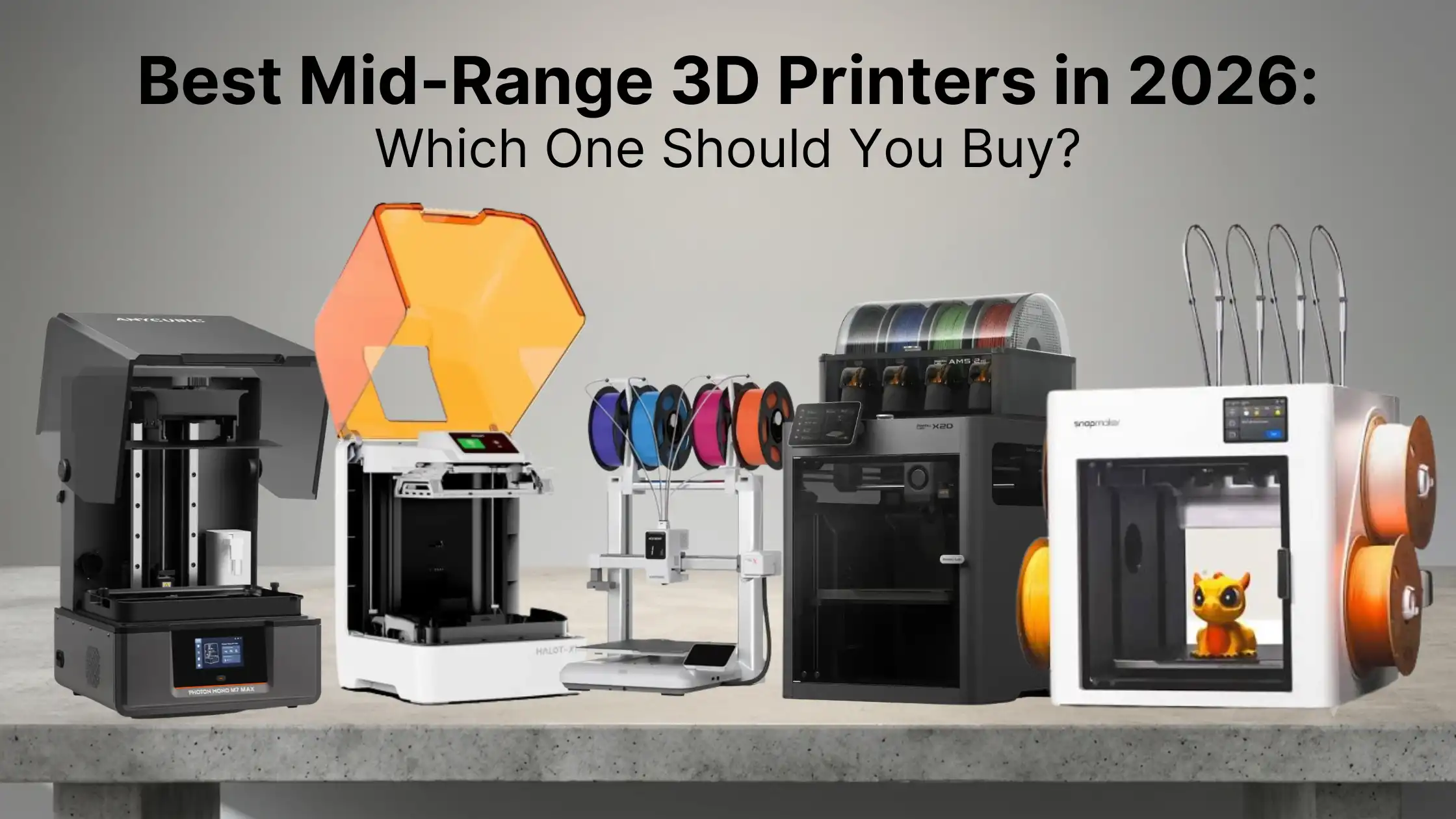
FDM remains a practical choice for functional parts, prototypes, larger models and a wide range of filament-based applications. The following models stand out for different types of users.
Anycubic Kobra X
Best for: Multicolor FDM printing
The Anycubic Kobra X is a strong option for users who want a capable FDM printer with multicolor functionality. It offers a 260 × 260 × 260 mm build volume, automatic leveling and a high-speed workflow.
More importantly, its multicolor capability makes it attractive for users who want to create visually complex models or explore more flexible printing workflows.
Therefore, consider the Kobra X if multicolor printing is an important part of your buying decision.
Bambu Lab P2S Combo
Best for: Automated everyday printing
The Bambu Lab P2S Combo focuses on a convenient and automated printing experience. It provides a 256 × 256 × 256 mm build volume and combines features such as AI error detection, live monitoring and AMS 2 Pro support.
As a result, it can suit users who want to spend less time managing the printing process and more time working on their models.
For regular prototyping and general-purpose printing, its workflow-focused design makes it a strong mid-range option.
Snapmaker U1
Best for: Multi-toolhead flexibility
The Snapmaker U1 takes a different approach by using multiple toolheads. It provides a 270 × 270 × 270 mm build volume and includes four toolheads, giving users greater flexibility when working with different materials or colors.
This makes it particularly interesting for users who want more than a conventional single-toolhead workflow.
So, if flexibility is more important to you than simply chasing maximum print speed, the U1 deserves consideration.
Bambu Lab X2D Combo
Best for: Advanced FDM applications
The Bambu Lab X2D Combo moves toward the more advanced end of the mid-range segment. Its dual-nozzle architecture and heated chamber capability give it greater flexibility for demanding FDM workflows.
Consequently, it can make sense for users who have already outgrown basic FDM printing and need more advanced capabilities for their projects.
Best Mid-Range Resin 3D Printers
FDM is not always the right technology. If fine details, surface quality and highly detailed models are your priority, resin printing can be a better fit.
Creality HALOT-X1
Best for: High-detail resin printing
The Creality HALOT-X1 is designed around detailed resin printing and ease of use. Its 16K mono LCD and fine pixel size make it suitable for users who prioritize detail.
It is therefore worth considering for detailed models where surface quality and fine features matter more than the broader material flexibility typically associated with FDM.
Anycubic Photon Mono M7 Max
Best for: Larger resin prints
The Anycubic Photon Mono M7 Max takes a different approach by offering a substantially larger resin build area.
This makes it useful for users who want the detail associated with resin printing but also need to produce larger models.
Therefore, if build size is one of your biggest limitations with smaller resin printers, this model is worth evaluating.
FDM vs Resin: Which Should You Choose?
The right technology depends on what you want to make.
In simple terms, choose FDM when versatility, larger parts and functional applications matter most. Choose resin when fine detail and surface quality are your priorities.
Which Mid-Range 3D Printer Is Right for You?
There is no single winner for every buyer.
Choose the Anycubic Kobra X if multicolor FDM printing is your priority.
Choose the Bambu Lab P2S Combo if you want an automated everyday workflow.
Choose the Snapmaker U1 if you want multi-toolhead flexibility.
Choose the Bambu Lab X2D Combo if you need more advanced dual-nozzle and heated-chamber capabilities.
Choose the Creality HALOT-X1 if detailed resin printing is your main requirement.
Choose the Anycubic Photon Mono M7 Max if you need a larger resin build area.
This approach is more useful than simply declaring one printer the “best” because your ideal machine depends on your workflow.
Is a Mid-Range 3D Printer Worth Buying?
Yes, especially if you have started to outgrow the limitations of an entry-level printer.
An upgrade can make sense when you need greater speed, larger prints, more materials, better reliability or additional automation.
However, if you only print occasionally and mainly use basic PLA, an entry-level printer may still meet your requirements.
Ultimately, buy for the workflow you actually need rather than paying for features you will rarely use.
FAQs
Q. What is considered a mid-range 3D printer?
Ans:- A mid-range 3D printer generally sits between entry-level and professional systems, offering more speed, automation, build volume or material capability.
Q. Which is the best mid-range 3D printer?
Ans:- The best option depends on whether you prioritize multicolor printing, automation, build volume, advanced FDM features or detailed resin printing.
Q. Are mid-range 3D printers good for beginners?
Ans:- Yes, particularly for beginners who expect to print regularly and want more capability than a basic entry-level printer.
Q. Is FDM better than resin?
Ans:- Neither is universally better; FDM suits larger functional parts while resin excels at detailed models and fine surface quality.
Q. Is a mid-range 3D printer suitable for small businesses?
Ans:- Yes, many mid-range FDM printers can support prototyping, custom parts, fixtures and small-batch production.
Q. Should I upgrade from an entry-level 3D printer?
Ans:- Consider upgrading when your current printer limits your build size, speed, material options, reliability or workflow.
Conclusion
A mid-range 3D printer can provide a useful balance between accessible printing and advanced capability. However, the right choice depends on your materials, print size, production frequency and workflow.
Instead of choosing purely by specifications, identify the features that solve your current limitations while giving you enough room to grow.
Explore mid-range FDM and resin 3D printers at 3Idea for your business requirements.
Shop on the App: https://play.google.com/store/apps/details?id=com.threeidea&pcampaignid=web_share