
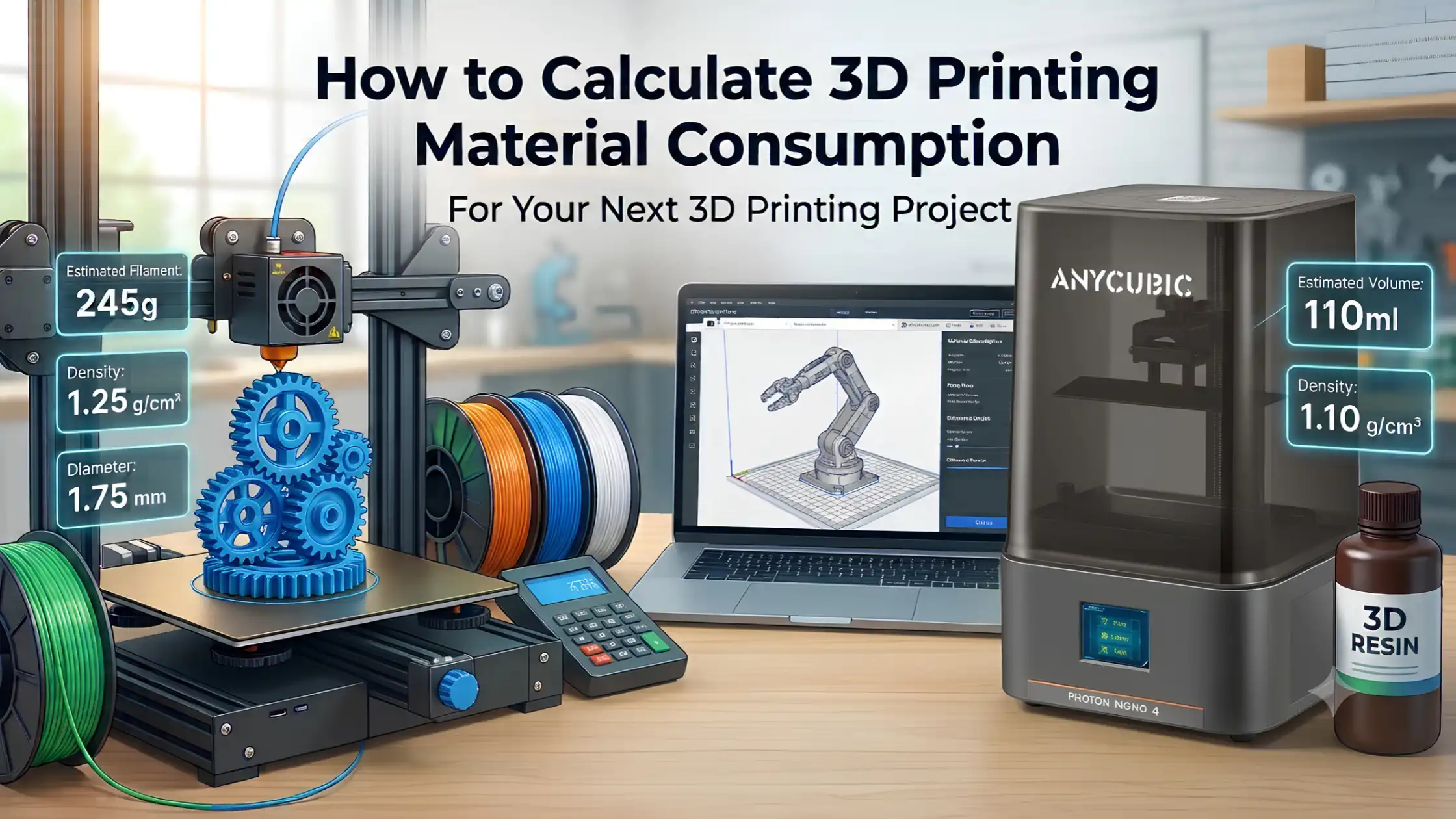
Before starting a 3D printing project, it helps to know how much material you will need. Whether you are printing a prototype, a replacement part, a decorative model or several components for a business, estimating material consumption helps you plan your filament requirements and budget more accurately.
Fortunately, you do not need to calculate every layer manually. For most FDM projects, slicing software provides an estimate based on your model and selected print settings. You can then multiply that estimate by the number of parts and account for any additional material your workflow may require.
What Is 3D Printing Material Consumption?
3D printing material consumption refers to the amount of material used to produce a printed object or complete project.
For FDM printing, consumption is commonly measured in grams or metres of filament. For resin printing, slicers generally estimate material by volume and may also provide a mass estimate.
However, material usage depends on more than the model's external dimensions. Infill, wall thickness, supports, purge material and failed prints can all affect the final quantity.
How to Calculate 3D Printing Material Consumption
1. Use your slicer's material estimate
The easiest approach is to import your 3D model into slicing software, configure your print settings and slice the model. The software estimates the material needed for the selected configuration.
For a project involving identical parts, use this formula:
Total material = Material required per part × Number of parts
For example, if your slicer estimates 40 grams for one component and you need 10 components, the base material requirement is 400 grams.
For projects containing different models, add the individual material estimates together instead of multiplying one estimate by the total number of parts.
2. Account for additional material
Your slicer's estimate is a useful starting point, but actual consumption may differ. Material changes, purge towers, setup extrusion and failed prints can increase usage, depending on your printer and workflow.
You can include a planning allowance when these losses are not already covered by your estimate.
Planned material = Base material requirement × (1 + Allowance rate)
The allowance should reflect your actual printing process rather than a fixed percentage that applies to every project.
Worked Example: Calculating Filament Required for a Project
Suppose you need to print eight identical parts, and your slicer estimates 42 grams of filament per part.
Base material: 42 g × 8 = 336 g
Illustrative 8% allowance: 336 g × 0.08 = 26.88 g
Total planned material: 336 g + 26.88 g = 362.88 g
You should therefore plan for approximately 363 grams of filament.
The 8% allowance is only an example, not a universal recommendation. If you are printing a well-tested design, your additional requirement may be lower. Conversely, a new design or a complex multi-colour print may need more material.
Before purchasing filament, also check the net material weight remaining on your spool. The spool itself does not count as usable filament.
What Affects 3D Printing Material Consumption?
Several settings and workflow decisions can change the amount of material your project requires.
Infill, walls and layer height
Infill density affects how much material goes inside a part. Higher infill generally increases consumption, while lower infill can reduce it when the design permits.
Wall count also matters because additional perimeters use more filament. However, the right balance depends on the part's strength and intended application.
Layer height influences the number of layers and print characteristics. Its effect on total material is not always straightforward, so use the slicer's estimate rather than assuming that a smaller layer height always means more material.
Supports and additional printing material
Some models require support structures to print overhangs or complex geometry. Brims and rafts can also consume extra filament.
Similarly, multi-colour printing may require purge material or a purge tower. Failed prints add to project consumption because the material used in unsuccessful attempts cannot always be recovered.
Therefore, review the slicer's preview and material estimate before starting a large batch.
How to Calculate the Material Cost of a 3D Print
Once you know the estimated material requirement, you can calculate its material cost.
Material cost = Cost per gram × Material used in grams
To calculate the cost per gram, divide the filament purchase cost by its net filament weight.
For example, if a spool costs ?1,200 and contains 1,000 grams of filament, its material cost is ?1.20 per gram. A print using 50 grams would consume ?60 worth of filament.
This calculation covers material only. Machine time, electricity, labour, finishing, maintenance and failed-print costs are separate. For business projects, consider these additional expenses when estimating the full production cost.
Does Resin 3D Printing Use Material Differently?
Yes. Resin printers generally estimate consumption by volume, although some slicers also display mass. The amount depends on the model, supports, hollowing, drainage and the resin remaining in the workflow.
When you need to convert a volume estimate into mass, use the resin manufacturer's density:
Mass = Volume × Density
Keep your units consistent. For instance, volume in cubic centimetres multiplied by density in grams per cubic centimetre gives mass in grams.
Remember that a model's external volume is not the same as the material consumed. Hollowing and internal geometry can significantly change the amount of resin required.
Choosing the Right Filament and 3D Printer
Material selection should match the purpose of your project. PLA is a practical option for many general-purpose models, learning projects and prototypes. PETG may suit applications that require different functional properties. In either case, check the material's specifications and your printer's compatibility before printing.
If you are planning regular projects, explore 3D printer filaments at 3Idea to compare suitable materials. You can also browse FDM 3D printers and check their supported filament types, build volume and operating requirements.
For more consistent planning, save your slicer settings for repeat jobs and compare estimated consumption with actual usage over time. This helps you make better material purchasing decisions, especially when printing multiple parts or fulfilling recurring orders.
Frequently Asked Questions
1. How do you calculate filament consumption for a 3D print?
Ans:- Use the slicer's estimated filament weight, multiply it by the number of parts and account separately for additional waste not already included.
2. How much filament does a typical 3D print use?
Ans:- It depends on the model's dimensions, walls, infill, supports and settings. A slicer's estimate is more useful than a generic average.
3. Does higher infill increase filament consumption?
Ans:- Generally, yes. Higher infill usually consumes more material, although the exact difference depends on the model and other print settings.
4. How accurate are 3D printer slicer material estimates?
Ans:- They provide useful planning estimates, but actual usage can differ because of purging, setup material, failed prints and extrusion variations.
5. How do you calculate the cost of filament used in a print?
Ans:- Divide the filament's purchase cost by its net weight to find the cost per gram, then multiply that figure by the grams consumed.
6. Can you calculate 3D printing material consumption without a slicer?
Ans:- You can estimate mass from material volume and density, but predicting actual usage is difficult because walls, infill and supports affect consumption.
Conclusion
Accurately estimating 3D printing material consumption starts with your slicer's material estimate. Multiply the amount required per part by the project quantity, then account for additional waste without counting the same losses twice. Finally, calculate material cost separately from machine and operating expenses.
With this approach, you can plan filament purchases, reduce unexpected shortages and estimate project requirements more confidently. Explore 3Idea's filament range and 3D printer collection to find materials and equipment suited to your next project.
Need an estimate for printing your own 3D model? Visit 3Idea's 3D Printing Service to calculate the printing cost for your model and plan your project budget before proceeding.
Explore More at 3Idea
Shop 3D printer filaments: https://www.3idea.in/category/filaments
Explore 3D printers: https://www.3idea.in/category/3d-printer
Read our 3D printing checklist: https://www.3idea.in/blog/3d-printer-checklist-important-things-to-do-before-during--after-printing
Download the 3Idea app for Android: https://play.google.com/store/apps/details?id=com.threeidea&pcampaignid=web_share
Download the 3Idea app for iOS: https://apps.apple.com/in/app/3idea/id6762472249