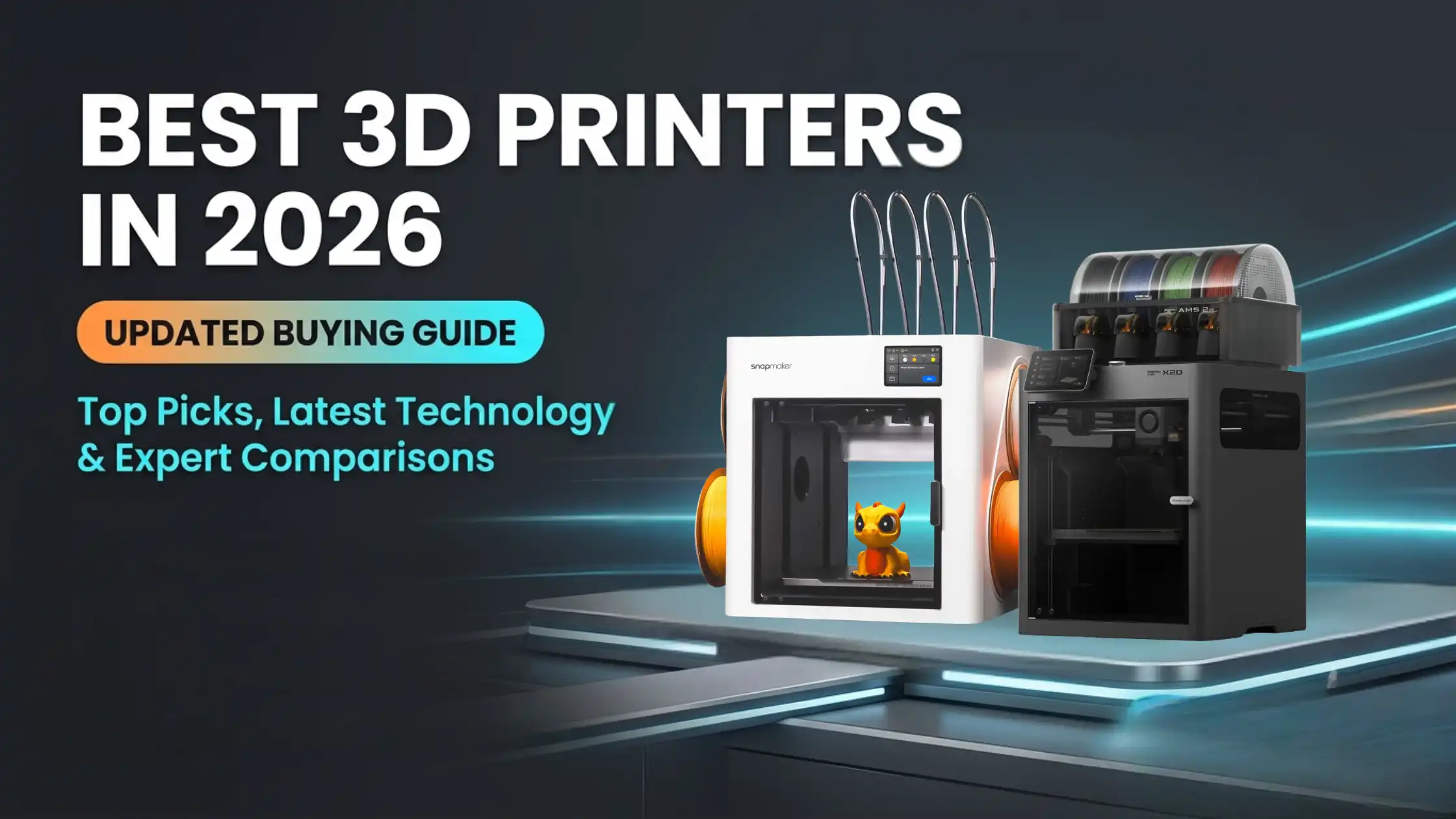
3D printing is moving faster than at any point in its history. The 2026 generation of printers brings genuine breakthroughs: CoreXY speed paired with reliability, multi-colour AMS systems that work out of the box, AI-driven print monitoring, and smart cloud ecosystems that let you manage a workshop from your phone. Choosing the best 3D printer in 2026 demands updated knowledge — last year’s “best” already isn’t.
This guide compares the top picks across FDM, resin, CoreXY, and hybrid manufacturing systems, explains the latest technology trends, and helps you find the right machine for your specific budget and use case.
Quick Picks: Best 3D Printers in 2026
These represent the top 3D printers in 2026 based on speed, reliability, print quality, ecosystem maturity, and ease of use. All are stocked on 3idea Technology with India warranty.
Top 3D Printers of 2025–2026
1. High-Speed CoreXY 3D Printers
CoreXY-architecture printers dominate the premium FDM segment in 2026. Their motion system delivers significantly higher speeds and acceleration than traditional Cartesian designs, with better surface quality at speed.
Recommended products:
Bambu Lab P2S Combo — slightly more affordable but still high-speed. Enclosed chamber, AMS support, and the same Bambu reliability. Excellent for small businesses growing into production work.
Best for: small businesses and prosumer users
Use case: functional parts, everyday production
Bambu Lab A1 Combo — the friendliest entry into the Bambu ecosystem. Automatic flow calibration, multi-colour AMS Lite, quiet operation, and an intuitive interface. Excellent for home users who want professional-grade results.
Best for: beginners and home users
Use case: everyday printing, hobby projects, creative work
2. Multi-Colour Smart 3D Printers
Multi-colour and multi-material printing has gone mainstream. Automatic filament switching systems — Bambu’s AMS, Anycubic’s ACE Pro, Creality’s CFS — turn what was an expert workflow into a one-click operation.
Recommended products:
Anycubic Kobra 3 Combo — among the best budget-friendly multi-colour systems in 2026. Multi-colour printing, high-speed performance, automatic levelling, and a beginner-friendly setup. Ideal for budget-conscious creators wanting to explore multi-colour work.
Best for: budget-conscious creators
Use case: colourful models, hobby projects, gift items
Bambu Lab A1 Mini Combo — compact, smart, and beginner-friendly. Small footprint, multi-colour AMS Lite support, mobile-app integration, and automatic flow calibration. One of the easiest first printers to recommend.
Best for: new users, students, and small home setups
Use case: education, creative printing, small-batch custom items
These systems are reshaping consumer 3D printing. Manual filament swaps are no longer a normal part of the workflow.
3. Resin (SLA / MSLA) 3D Printers
Resin printers deliver detail and surface finish that FDM cannot match. They’re essential for miniatures, dental, jewellery, and high-precision prototyping.
Recommended products:
Elegoo Saturn 4 Ultra — a powerful large-format resin printer with high-speed tilt-release technology and excellent print quality. The benchmark for serious resin work.
Best for: professionals and serious creators
Use case: miniatures, dental models, jewellery prototypes, detailed engineering parts
Elegoo Mars Series — affordable, reliable resin printing for hobbyists and beginners. Compact, beginner-friendly, and an excellent way to enter resin printing without major capital.
Best for: hobbyists, miniature painters, beginners
Use case: detail-focused prints, miniatures, jewellery
For high-detail work and small-batch production, resin remains the technology to choose.
4. Entry-Level FDM 3D Printers
Affordable FDM remains the best entry point into 3D printing — and 2026’s entry-level machines are dramatically more capable than the entry-level of even two years ago.
Recommended products:
Anycubic Kobra Series (Kobra 2 Neo / Kobra 3) — reliable, affordable, beginner-friendly printers with auto bed levelling, easy assembly, and good print quality. Strong India service presence through 3idea.
Best for: beginners and students
Use case: learning, DIY projects, hobby work
Bambu Lab A1 Mini — one of the easiest plug-and-play printers available. Smart calibration, compact design, high reliability, and a polished software experience.
Best for: first-time users
Use case: home projects, educational printing
For new buyers in India with a budget under ?30,000, the Anycubic Kobra and Bambu Lab A1 Mini are the two safest choices.
5. Industrial Desktop 3D Printers
For startups, design studios, and engineering teams, industrial desktop machines balance speed, reliability, and material flexibility.
Recommended products:
Snapmaker U1 — a premium all-in-one manufacturing system. Modular workflow, smart touchscreen ecosystem, multi-material support, and industrial-grade stability. Ideal for studios and small manufacturers needing flexibility.
Best for: startups, design studios, small manufacturers
Use case: product development, multi-process workflows
Bambu Lab H2 Series — high-performance industrial 3D printing engineered for demanding engineering-grade materials. Dual-extrusion CoreXY architecture, high-temperature active chamber heating, automated nozzle alignment, multi-material AMS integration, and advanced thermal management. Built for enterprise environments requiring continuous production with peak material stability.
Best for: industrial designers, R&D labs, and engineering teams
Use case: high-temp end-use parts, multi-material prototypes, functional testing
These machines bridge the gap between consumer and industrial systems — desktop footprint with production-grade capability.
6. Laser Engraving and Hybrid Manufacturing Systems
Laser engraving has become integral to maker workflows. Many creators now combine 3D printing with engraving and cutting for end-to-end production capability.
Recommended products:
Creality Falcon2 Laser Engraver — a high-performance laser engraver from Creality. High engraving precision, fast cutting performance, material versatility, and safety-focused design.
Best for: makers and small businesses
Use case: engraving, cutting, customisation work
Snapmaker Multi-Function Systems — modular machines that combine 3D printing, laser engraving, and CNC carving in one device.
Best for: workshops and creators needing multi-process flexibility
Use case: complete maker production workflows
For a studio or small workshop that needs both additive and subtractive capability, these multi-process machines deliver remarkable value.
Comparison Table: Best 3D Printer 2026
This best 3D printer comparison 2026 highlights the key trade-offs between technologies and use cases. Match the technology to your application, not the other way round.
Latest 3D Printing Technology in 2026
Four trends are reshaping the industry.
AI-Powered 3D Printing
Modern printers now use AI for:
Real-time error detection (spaghetti, lifted layers, missing prints)
Print optimisation based on geometry analysis
Predictive failure prevention
Automatic calibration
The biggest practical impact: print success rates climb from 70–80% to 95%+ for users who let the AI do its job.
High-Speed Printing Systems
The combination of CoreXY motion, input shaping, high-flow hotends, and modern firmware has pushed practical print speeds 4–8× faster than just a few years ago. A part that took 12 hours on an Ender 3 in 2022 takes 2 hours on a Bambu Lab P1S in 2026 — at equal or better quality.
Smart Ecosystems
Cloud printing, mobile-app control, remote monitoring, and automatic firmware updates have moved 3D printing from “operating a machine” to “managing a workflow”. The best 2026 printers are as much software products as hardware.
Multi-Material and Multi-Colour Systems
Automatic filament switching is now mainstream. The current generation handles soluble supports, advanced material combinations, and full-colour models that previously required industrial-class systems.
These four trends are shaping the future of latest 3D printer technology workflows.
FDM vs Resin 3D Printer (2026)
A clear comparison for buyers choosing between the two technologies.
FDM Printers
Strengths:
More affordable across the range
Easier maintenance and handling
Larger build volumes available
Better for functional parts and engineering materials
Wider material range
Best for: home use, prototyping, functional mechanical parts, large prints
Resin Printers
Strengths:
Extremely high detail and surface finish
Smooth, almost moulded-looking output
Superior dimensional precision for small parts
Best for: jewellery, dental, miniatures, high-detail prototypes, jewellery casting masters
In the FDM vs resin comparison, FDM wins on versatility, resin wins on detail and finish. Most professional users now have both.
How to Choose the Best 3D Printer
Buyers in 2026 should evaluate four dimensions before deciding.
1. Budget
Set a realistic total budget — printer plus filament, slicer software (if paid), accessories, and a contingency for spare parts. Avoid pushing the entire budget into the printer and leaving nothing for materials.
2. Use Case
Decide whether your primary focus is hobby printing, business production, professional prototyping, or educational use. Each has different priorities — ease of use vs uptime vs raw quality.
3. Skill Level
Beginners should prioritise printers with auto-levelling, smart calibration, and plug-and-play setup. Bambu Lab A1 Mini and Anycubic Kobra 2 lead this category.
4. Material Compatibility
Check support for the materials you actually plan to use:
PLA — basic, every printer supports it
PETG — most printers handle it well
ABS / ASA — need an enclosed chamber
Nylon / PA-CF / PETG-CF — need high-temp hotend and an enclosure
TPU — direct-drive extruder preferred
Match the printer to the materials, not the materials to the printer.
Beginner Mistakes When Buying 3D Printers
The most common (and most expensive) buying mistakes:
Buying purely on price. A ?15,000 printer with no India service costs more than a ?35,000 printer with strong service over three years of use.
Ignoring spare-parts availability. Imported-only spares add weeks of downtime.
Choosing unsupported brands. Quirky brands look attractive but lack community and slicer support.
Overlooking print speed. Slow printers waste hours of operator time daily.
Ignoring the software ecosystem. A great printer with a bad slicer is a daily frustration.
A little research upfront prevents months of regret.
Best 3D Printer for Different Use Cases
Use this as your starting point. Each row reflects the strongest current pick in its category.
Conclusion
The best 3D printer in 2026 depends entirely on your specific workflow, budget, and goals. The good news: the technology has matured to the point that almost every category has a clear best-in-class machine.
The latest generation offers:
Significantly faster print speeds via CoreXY and input shaping
AI-powered print monitoring that catches failures in real time
Smart cloud ecosystems for remote management
Multi-colour support that works out of the box
Better overall reliability than any previous generation
Bambu Lab leads the premium high-speed category. Anycubic continues to dominate the budget-friendly segment. Elegoo remains the strongest in resin. Creality and Snapmaker are expanding the hybrid manufacturing landscape. All are stocked on 3idea Technology with India warranty, technical support, and spare-part availability.
Explore the full range on 3idea: https://www.3idea.in/products/3d-printers
Choose the right machine, and 3D printing unlocks powerful opportunities for creativity, business, and production.
FAQs
Q. Which is the best 3D printer in 2026?
Ans: High-speed CoreXY printers like the Bambu Lab H2 Series are currently the best overall option. For budget-conscious buyers, the Anycubic Kobra 3 Combo offers excellent value.
Q. What is the latest 3D printing technology?
Ans: AI-powered print monitoring, smart cloud ecosystems, multi-material AMS-style systems, and high-speed CoreXY motion are the dominant 2026 trends.
Q. Which 3D printer should I buy?
Ans: Choose based on your budget, primary use case, skill level, and the materials you plan to use. For most beginners in India, the Bambu Lab A1 Mini or Anycubic Kobra 2 Neo are the safest first choices.
Q. Is resin printing better than FDM?
Ans: Resin printing offers better detail and surface finish; FDM is more affordable, easier to maintain, and better for functional parts. Most professional users now have both technologies.
Q. Which printer is best for beginners?
Ans: The Bambu Lab A1 Mini and Anycubic Kobra 2 Neo are the two best beginner-friendly options in 2026.