
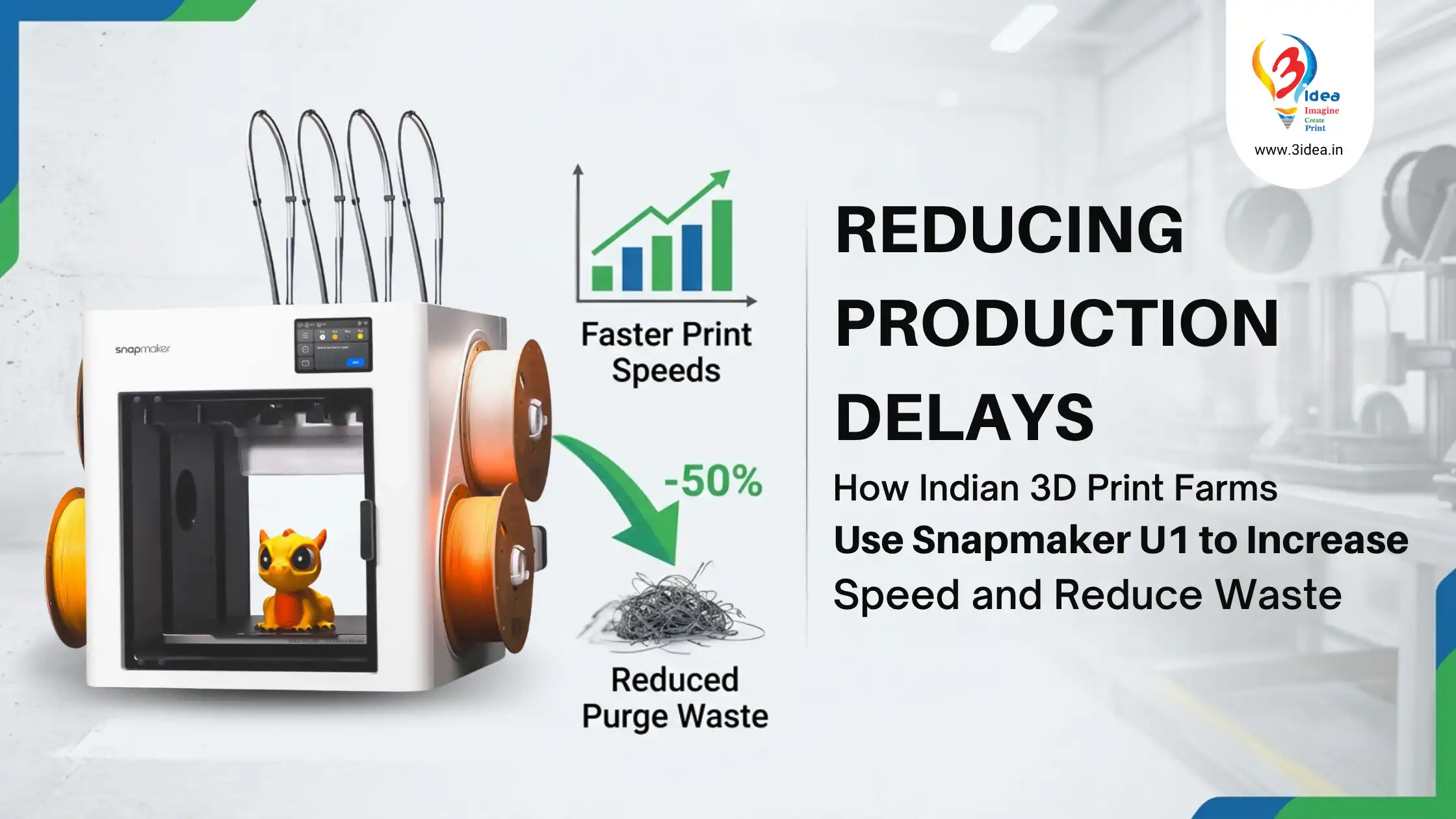
As India's additive manufacturing industry continues to grow, 3D print farms are under increasing pressure to deliver faster turnaround times while maintaining profitability. Whether producing functional prototypes, manufacturing aids, custom products, or production parts, speed and efficiency have become critical competitive advantages.
However, many print farms face a common challenge: increasing production capacity without significantly increasing operating costs.
Two major factors often limit scalability:
Slow production cycles
Excessive purge waste during multi-material printing
To address these challenges, many Indian print farms are adopting advanced systems such as the Snapmaker U1, designed to deliver higher print speeds, smarter material management, and improved production efficiency.
In this article, we'll explore how the Snapmaker U1 helps print farms increase output, reduce material wastage, and minimize production delays.
Why Production Delays Are Common in Growing Print Farms
As order volumes increase, small inefficiencies quickly become major bottlenecks.
Some of the most common causes of production delays include:
Long print completion times
Frequent material changes
Excessive purge waste during filament switching
Print failures caused by inconsistent material flow
Machine idle time between jobs
Operator dependency for routine tasks
Inefficient overnight production management
These challenges not only affect delivery timelines but also increase production costs and reduce overall profitability.
The Hidden Cost of Slow Printing and Purge Waste
Many print farms focus only on machine count when scaling production. However, actual productivity depends on how efficiently each machine operates.
Two factors have the biggest impact:
Print Speed
A machine that completes jobs faster allows operators to:
Produce more parts per day
Accept larger order volumes
Meet urgent customer requirements
Improve machine utilization
Even a small reduction in print time can significantly increase monthly output across multiple machines.
Purge Waste
In multi-material and multi-color printing environments, filament changes often generate large amounts of purge material.
Excessive purge waste results in:
Higher material costs
Increased environmental impact
Longer print times
Reduced profitability
Reducing purge waste has become a key objective for modern print farms seeking greater operational efficiency.
How Snapmaker U1 Helps Print Farms Increase Print Speed
The Snapmaker U1 is engineered for high-throughput production environments where speed and consistency are critical.
Its advanced motion system and optimized printing architecture allow operators to complete jobs significantly faster than traditional desktop systems.
Faster Production Cycles
Higher printing speeds enable:
More completed jobs per machine
Improved production scheduling
Faster customer deliveries
Better return on equipment investment
For print farms running multiple printers simultaneously, these productivity gains quickly compound into substantial output increases.
Reduced Lead Times
Faster printing allows operators to:
Handle urgent orders more efficiently
Reduce production backlogs
Improve customer satisfaction
Increase order capacity without expanding floor space
As demand grows, high-speed printing becomes an essential factor in maintaining competitiveness.
How Snapmaker U1 Reduces Purge Waste
One of the standout advantages of the Snapmaker U1 is its intelligent approach to multi-material printing.
Traditional multi-material systems often generate significant purge waste whenever materials or colors are switched.
The Snapmaker U1 is designed to optimize these transitions and reduce unnecessary filament consumption.
Smarter Material Switching
Efficient filament management helps:
Reduce wasted material during changes
Improve overall material utilization
Lower operating costs
Maintain consistent print quality
Better Cost Efficiency
For print farms processing large production volumes, even small reductions in purge waste can generate substantial savings over time.
Benefits include:
Lower filament consumption
Reduced production costs
Improved profit margins
More sustainable manufacturing operations
Why Reducing Purge Waste Matters for Print Farms
Many operators underestimate how much material is lost through purging over the course of a month.
When multiplied across:
Multiple printers
Multi-color jobs
Multi-material applications
Continuous production schedules
The amount of wasted filament can become significant.
Reducing purge waste helps print farms:
Lower material expenses
Improve sustainability goals
Increase usable output per spool
Enhance production efficiency
For businesses focused on scaling operations, material optimization is just as important as print speed.
Combining Speed and Efficiency for Higher Productivity
The real advantage of the Snapmaker U1 lies in its ability to improve both production speed and material efficiency simultaneously.
Many printers can print fast.
Many printers can print multi-material parts.
Few systems effectively address both speed and waste reduction at the same time.
This combination allows print farms to:
Increase Daily Output: More jobs can be completed within the same production window.
Improve Profitability: Lower material wastage means more revenue from every spool used.
Maximize Machine Utilization: Printers spend more time producing parts and less time handling material-related inefficiencies.
Support Business Growth: Higher productivity enables print farms to scale without proportionally increasing labor or equipment costs.
Industries Benefiting from Faster and More Efficient Production
Indian print farms serve customers across a wide range of sectors, including:
Manufacturing
Automotive
Product Design
Consumer Goods
Education
Architecture
Engineering Services
Research & Development
Across all these industries, customers increasingly expect:
Faster delivery
Consistent quality
Competitive pricing
Reliable production schedules
Improving print speed and reducing material waste directly supports these expectations.
Best Practices for Maximizing Snapmaker U1 Performance
To achieve the best results, print farms should combine advanced equipment with optimized workflows.
Optimize Print Scheduling: Group similar jobs together to maximize machine productivity.
Monitor Material Consumption: Track filament usage and identify opportunities to reduce waste.
Standardize Production Settings: Consistent print profiles help improve reliability and repeatability.
Utilize Overnight Production: Take advantage of unattended printing to increase daily output.
Maintain Equipment Regularly: Preventive maintenance minimizes downtime and ensures consistent performance.
When paired with the capabilities of the Snapmaker U1, these practices can significantly improve production efficiency.
The Future of High-Performance Print Farms in India
As additive manufacturing adoption accelerates, print farms must focus on:
Higher throughput
Lower operating costs
Material optimization
Scalable production workflows
The ability to print faster while reducing waste will become a major competitive differentiator.
Solutions like the Snapmaker U1 help operators meet these demands by improving productivity, reducing material consumption, and enabling more efficient production management.
Conclusion
For modern Indian 3D print farms, reducing production delays requires more than simply adding more printers.
The real opportunity lies in improving the efficiency of every machine through faster printing and smarter material utilization.
The Snapmaker U1 addresses both challenges by helping operators increase print speed while also reducing purge waste, enabling higher productivity and lower operating costs.
As customer expectations continue to rise, investing in technologies that improve output, reduce waste, and streamline production workflows will be essential for long-term growth and profitability.
Frequently Asked Questions
Q. How does the Snapmaker U1 help increase print speed?
Ans: The Snapmaker U1 is designed with a high-performance printing system that enables faster production cycles, allowing print farms to complete more jobs within the same timeframe.
Q. What is purge waste in 3D printing?
Ans: Purge waste refers to the filament discarded during material or color changes in multi-material printing processes to ensure clean transitions between materials.
Q. Why is reducing purge waste important?
Ans: Reducing purge waste lowers material costs, improves sustainability, increases material efficiency, and enhances overall profitability.
Q. How can print farms reduce production delays?
Ans: Print farms can reduce delays by increasing print speed, automating workflows, optimizing job scheduling, minimizing material waste, and improving machine utilization.
Q. Is the Snapmaker U1 suitable for high-volume print farms?
Ans: Yes. Its combination of high-speed printing, intelligent material management, and production-focused design makes it well-suited for growing print farm operations.