
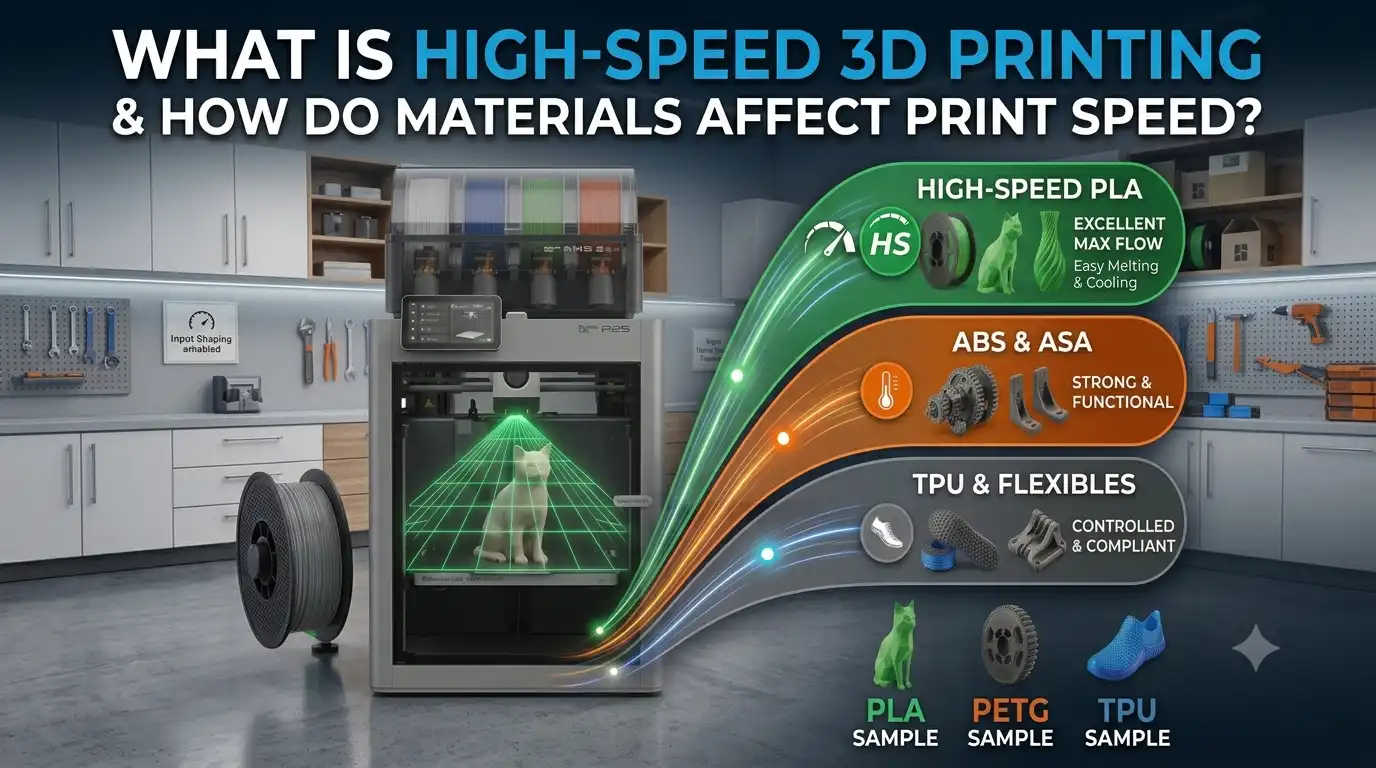
A 3D printer advertised at 500 or 600 mm/s does not necessarily print every model at that speed.
In reality, high-speed 3D printing depends on much more than the maximum speed shown in a printer's specifications. The motion system, hotend, extruder, filament, temperature, cooling and print settings all need to work together.
Moreover, different materials behave differently during extrusion. PLA can usually handle rapid printing more easily, while PETG, ABS, ASA and TPU may require more careful control.
So, before increasing your speed settings, it is important to understand what actually limits printing speed and how your choice of filament affects the result.
What Is High-Speed 3D Printing?
High-speed 3D printing refers to FDM printing at significantly higher movement and extrusion rates than traditional printing workflows.
However, maximum movement speed and actual printing speed are not the same thing. A printer might reach 500 or 600 mm/s during certain movements, but a typical model may spend much of its time at lower speeds because of acceleration, geometry and extrusion requirements.
One of the most important concepts here is volumetric flow.
Simply put, the faster you move the print head, the more material the hotend needs to melt and push through the nozzle. This relationship becomes even more demanding when you use thicker layers or wider extrusion lines.
Therefore, a printer can move extremely fast, but if the hotend cannot melt and extrude enough filament, increasing the speed will eventually cause under-extrusion and poor print quality.
What Determines 3D Printing Speed?
Several factors determine how quickly an FDM printer can produce a usable part.
Motion System:- A rigid frame and capable motion system help a printer handle rapid movements and acceleration. Modern CoreXY designs, for example, can support fast movement while maintaining good mechanical stability.
Extrusion System:- The extruder and hotend must maintain consistent filament flow at higher speeds. A high-flow hotend becomes particularly important when the printer demands large amounts of molten material.
Volumetric Flow:- Volumetric flow is one of the biggest limitations in high-speed printing. It describes how much material the hotend can melt and extrude over a given period. Consequently, simply increasing the mm/s value does not guarantee faster printing.
Nozzle Size:- A larger nozzle can move more material because it allows wider extrusion paths. However, it can also reduce fine detail, so nozzle size should match the application.
Acceleration:- A printer may advertise a very high maximum speed, but small models often do not provide enough distance for the print head to reach that speed. As a result, acceleration can have a major impact on real-world print times.
Cooling:- Higher speeds give each layer less time to cool before the next layer arrives. Therefore, effective part cooling becomes increasingly important, particularly with materials that need rapid solidification.
How Do FAffect 3D Printing Speed?
The filament you use can significantly change how quickly you can print while maintaining acceptable quality.
PLA:- PLA is generally one of the easiest materials for fast FDM printing. It melts readily and can cool relatively quickly, which makes it well suited to high-speed applications. For everyday prototypes, models and general-purpose parts, PLA is often a practical starting point.
High-Speed PLA:- High-speed PLA is designed with faster extrusion in mind. Its formulation can help maintain consistent flow at higher rates, making it particularly suitable for modern high-speed FDM printers. However, you should still follow the filament manufacturer's recommended temperature and flow limits.
PETG:- PETG offers a useful balance between strength and ease of printing. Nevertheless, pushing it too quickly can affect surface quality, stringing and extrusion consistency. High-speed PETG can improve this balance because it is formulated for higher extrusion rates.
ABS and ASA:- ABS and ASA can support relatively fast printing, but speed is only one part of the equation. These materials are more sensitive to temperature and cooling conditions. Therefore, a controlled thermal environment can become important, particularly for larger parts where warping and layer adhesion are concerns.
TPU:- TPU behaves differently from rigid filaments because it is flexible. The material can compress or buckle within the extrusion path when pushed too aggressively. As a result, TPU generally requires more conservative speeds, depending on the specific filament and printer combination.
Why Is High-Speed Filament Different?
High-speed filament is not simply regular filament with a higher speed setting.
Instead, the material needs to maintain consistent extrusion at higher flow rates. Its melt behaviour, thermal characteristics, dimensional consistency and recommended temperature range all influence performance.
This creates an important distinction:
A printer may be capable of moving at 600 mm/s, but the filament still needs to flow consistently at the required rate.
That is why printer capability and filament capability should always be considered together.
Can Any 3D Printer Print at High Speed?
No. A basic printer cannot necessarily achieve reliable high-speed printing simply by increasing its speed settings.
A high-speed FDM setup generally benefits from:
A rigid frame
A capable motion system
High acceleration
A high-flow hotend
A suitable extrusion system
Effective cooling
Input shaping
Pressure advance and flow calibration
Automatic bed levelling
Appropriate material profiles
For example, the Snapmaker U1 is a strong example of a printer designed around fast, multi-material FDM printing. It offers up to 500 mm/s toolhead speed, high acceleration and a high-flow extrusion system, making it relevant when both speed and material flexibility matter.
The Anycubic Kobra X is another suitable example for high-speed FDM and multicolor printing, with a high maximum movement speed, 300°C nozzle capability and compatibility with materials including PLA, PETG, TPU and selected engineering-oriented filaments.
Meanwhile, the Bambu Lab P2S Combo demonstrates how modern high-speed printing is about more than raw movement speed. Automation, monitoring, filament management and reliable print workflows can make fast printing much more practical.
How to Choose Materials for High-Speed 3D Printing
Choosing the right filament starts with the part you want to produce.
For maximum everyday speed: PLA or high-speed PLA is usually the easiest choice.
For a balance of strength and speed: PETG or high-speed PETG can be a better option.
For heat and UV-resistant applications: ABS or ASA can work well when the printer provides suitable thermal control.
For flexible parts: TPU is suitable, but you will generally need to reduce the speed compared with rigid materials.
Most importantly, do not blindly copy the maximum speed listed for your printer. Instead, check the filament manufacturer's recommended temperature, speed and flow range and adjust your settings accordingly.
Also, keep your filament dry. Moisture can affect extrusion consistency and print quality, particularly when printing at demanding speeds.
Does Higher Print Speed Reduce Print Quality?
It can.
When you push a printer beyond the practical limits of its extrusion and motion systems, you may notice:
Under-extrusion
Ringing or ghosting
Poor layer adhesion
Inconsistent walls
Poor overhangs
Reduced surface quality
Mechanical instability
Therefore, the goal of high-speed 3D printing should not simply be to use the highest possible mm/s setting.
Instead, the goal is to achieve the shortest practical print time while maintaining the level of quality your application requires.
That balance is what makes a high-speed printer genuinely useful.
Which High-Speed 3D Printer Features Should You Look For?
If speed is an important buying factor, look beyond the headline maximum speed.
Prioritize features such as:
High-flow hotend
Strong extrusion system
High acceleration
Rigid motion system
Effective cooling
Input shaping
Pressure advance or flow calibration
Automatic bed levelling
High-temperature nozzle
Optimized material profiles
Enclosure or chamber control for engineering materials
The Bambu Lab P2S Combo, for example, combines high-speed FDM printing with automated features and material management. This approach shows why a good high-speed printer should improve the entire workflow rather than simply move the print head faster.
Which Material Is Best for High-Speed 3D Printing?
PLA and high-speed PLA: Best for everyday fast printing.
PETG and high-speed PETG: Best when you want a stronger balance between speed and functional performance.
ABS and ASA: Better suited to engineering applications when appropriate thermal control is available.
TPU: Useful for flexible applications, but generally requires lower speeds.
Ultimately, the best material depends on the part you are printing, not just the speed you want to achieve.
Conclusion
High-speed 3D printing is not simply about selecting the highest number in a printer's specifications. The printer, hotend, extrusion system, filament, temperature and cooling must work together. PLA and high-speed PLA are generally easiest for rapid printing, while PETG, ABS, ASA and TPU require more careful control. Choosing the right combination can reduce print time without unnecessarily sacrificing quality.
Ready to optimize your setup? Explore our full collection of high-speed filaments on 3Idea Web, or download the 3Idea app on Android and iOS to order on the go.
Frequently Asked Questions
Q. What is high-speed 3D printing?
Ans:- High-speed 3D printing uses higher movement and extrusion rates while maintaining acceptable print quality through suitable hardware, materials and settings.
Q. Which filament is best for high-speed 3D printing?
Ans:- PLA and high-speed PLA are generally the easiest choices for rapid FDM printing, while high-speed PETG offers a stronger functional alternative.
Q. Can PLA be printed at high speed?
Ans:- Yes, PLA is generally well suited to high-speed printing when the printer, hotend, cooling and filament support the required extrusion rate.
Q. Does PETG print slower than PLA?
Ans:- PETG can be printed quickly, but it often needs more careful temperature, flow and cooling control than PLA.
Q. Why does filament affect 3D printing speed?
Ans:- Different filaments have different melting, flow, cooling and extrusion characteristics, which determine how quickly they can be printed reliably.
Q. Can TPU be used for high-speed 3D printing?
Ans:- TPU can be printed quickly on suitable systems, but its flexibility generally makes it more challenging to extrude at very high speeds.
Q. Does higher print speed reduce print quality?
Ans:- Excessive speed can cause under-extrusion, ringing, poor layer adhesion and surface defects when the printer or material cannot maintain the required performance.
Q. Is a 600 mm/s 3D printer always faster?
Ans:- No. Maximum movement speed does not represent the printer's real-world print speed because acceleration, geometry, volumetric flow and material limitations also matter.